













1st Atlantic Storm of Season Threatens Carolinas

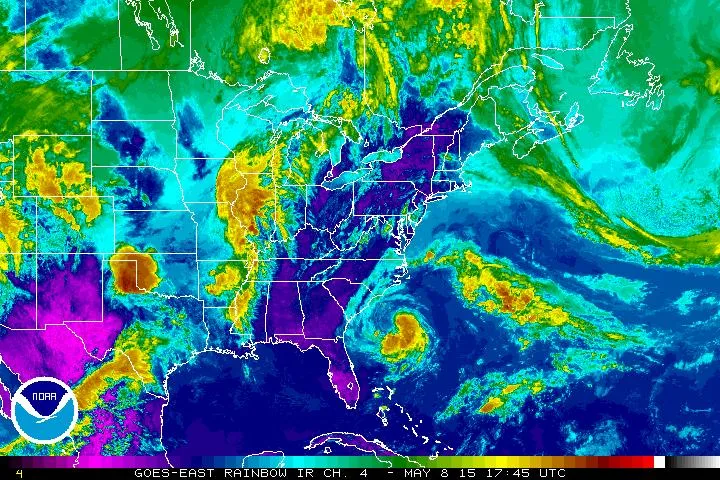
A slow-moving subtropical storm could make landfall in the southeastern United States by Sunday (May 10), lashing the Carolinas with several inches of rain and strong winds over the weekend.
Subtropical Storm Ana is expected to strengthen into a tropical system as it drifts over the warm Gulf Stream current today (May 8), said James Franklin, chief of the National Hurricane Center's Hurricane Specialist Unit in Miami.
A tropical storm watch is in effect for Cape Lookout, North Carolina, south to Edisto Beach, South Carolina. The latest forecast from the National Hurricane Center calls for 2 to 4 inches (5 to 10 centimeters) of rain in the coastal Carolinas, with up to 6 inches (15 cm) in areas hit by heavy thunderstorms. The storm is also creating rough surf along the coast, and Franklin warned of deadly rip currents throughout the weekend.
"It's the rip currents that we are worried about the most," Franklin said.
Ana is currently centered about 160 miles (257 kilometers) south-southeast of Myrtle Beach, South Carolina, and is moving north-northwest at about 1 mph (1.6 km/h). Winds are near 45 mph (72 km/h), and are expected to strengthen only slightly through the weekend. [A History of Destruction: 8 Great Hurricanes]
A subtropical storm is different in several ways from the tropical depressions that usually spin up into hurricanes. Subtropical storms appear in the mid-latitudes instead of the tropics. The storms also have cold, low-pressure centers in place of the warm, high-pressure interiors of tropical cyclones, Franklin said. The storms also tend to have different energy sources, with subtropical storms driven by atmospheric temperature differences and tropical storms powered by warm water. That's why subtropical Storm Ana's meandering path over the balmy Gulf Stream current is strengthening its transition into a tropical storm, Franklin said.
"Right now, Ana is over the Gulf Stream, and it can get more and more of its energy from below," Franklin said.
Get the world’s most fascinating discoveries delivered straight to your inbox.
Subtropical Storm Ana is the first named storm of the 2015 Atlantic hurricane season, which officially begins on June 1 and ends on Nov. 30.
Franklin said "preseason" May storms aren't unusual; they appear every six years, on average. However, Ana is the earliest Atlantic storm to emerge since 2003, when another subtropical storm named Ana formed in April. There have been 21 years with named storms in May since 1851, Franklin said. (A storm is named when its winds reach 39 mph, or 63 km/h.)
Early forecasts have called for a quiet Atlantic hurricane season because of El Niño conditions in the Pacific Ocean. The El Niño climate pattern hinders Atlantic hurricanes and boosts the formation of Pacific cyclones and typhoons. The National Oceanic and Atmospheric Administration is expected to announce its first seasonal forecast for the 2015 hurricane season later this month.
Follow Becky Oskin @beckyoskin. Follow Live Science @livescience, Facebook & Google+. Originally published on Live Science.
