
 Live Science Plus


Did Mammals Sleep Through Cosmic Impact That Ended Dinosaurs?

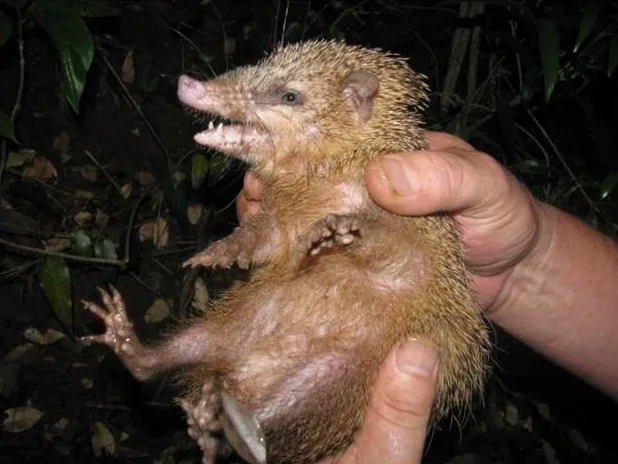
A shrewlike creature in Madagascar that can hibernate for at least nine months of the year without waking may help reveal how mammals survived the cataclysm that ended the age of dinosaurs, researchers suggest.
These findings could also help lead to a way to put astronauts in a state of suspended animation on journeys in deep space and for victims of medical emergencies, scientists added.
The disaster that killed off all dinosaurs except birds about 67 million years ago, the so-called end-Cretaceous extinction event, was probably a giant cosmic impact that struck near what is now Chicxulub, Mexico. To find out how the ancestors of today's mammals survived this catastrophe to inherit the Earth when so many other, more dominant groups of animals did not, researchers investigated the life of "Shrëwdinger" — a virtual example, developed in a prior study, of the small, insect-eating, furry-tailed creature that was the likely forerunner of most living mammals. [See Images of the Furry Mammal Ancestor and Descendants]

Living fossils
To understand more about Shrëwdinger, investigators chose "to hunt down the closest living resemblance to Shrëwdinger and to see if, and how, it differs from other modern animals," said study lead author Barry Lovegrove, an evolutionary physiologist at the University of KwaZulu-Natal in South Africa. "I suspected that such a creature should exist in Madagascar."

After the end-Cretaceous extinction event, mammals inherited a tropical Earth. "Madagascar has remained tropical and semitropical for the last 50 million years," Lovegrove said. This made this island off the African coast a potentially good place to look for mammals that have continued to live in the same way as the survivors of the last mass extinction did.
The scientists focused on the common tenrec, a shrewlike mammal that is one of the largest living insect-eating mammals and which greatly resembles Shrëwdinger. The common tenrec, which weighs about 2.2 lbs. (1 kilogram), is slightly larger than Shrëwdinger, which was estimated to weigh between 0.01 and 0.55 lbs. (6 to 250 grams), but in many other respects it has a similar, insect-eating lifestyle, Lovegrove said.
Get the world’s most fascinating discoveries delivered straight to your inbox.
Tenrecs are part of a group of mammals known as the Afrotheria, which were perhaps the first new mammal group to evolve from Shrëwdinger at the beginning of the age of mammals, the Cenozoic Era, about 65 million years ago, Lovegrove said. Tenrecs arrived in Madagascar "perhaps as early as 50 million years ago, during the Eocene Epoch, which was the hottest and most tropical time that the Earth had been for hundreds of millions of years," Lovegrove said.
Since the climate in which tenrecs have lived has changed little for millions of years, Lovegrove said equally little seems to have changed regarding how tenrecs respond to environmental factors such as climate, a phenomenon known as phylogenetic inertia.
"I regard the common tenrec as a living fossil," Lovegrove said.
Fieldwork in Madagascar
Lovegrove's two graduate students, Keri Lobban and Danielle Levesque, lived in tents conducting research over two rainy seasons in Madagascar from 2009 to 20011.
"Nighttime in Madagascar forests is absolutely magical, teeming with weird and wonderful creatures — eyes glaring at you from all directions as you scan the forests with headlamps, harmless boas slithering past ever so often, rustling of branches as the lemurs shift around in the trees," Lobban told Live Science. "And the sounds — oh, the sounds! Eerie songs of the avahi [woolly lemurs] and high-pitched squeaks of the mouse lemurs. Nighttime in Madagscar is something to be experienced." [In Photos: The Wacky Animals of Madagascar]
During the night, the scientists ultimately hand-captured 22 tenrecs, which they fed with live insects and tinned sardines.
"When we heard the characteristic rustle of a tenrec in the surrounding forest, my guide or guides would circle the animal and flush it out onto the path where I could either sneak up to it or grab it quickly," Lobban said. "The renowned poor eyesight of tenrecs definitely worked in my favor."
The researchers surgically implanted 15 tenrecs with radio transmitters and sensors that monitored their body temperatures, and then they released them back in the wild — the other tenrecs were either too small or too infested with parasites to safely implant. [See Images of the Tenrecs in Madagasar and Implants]
A number of the tagged tenrecs were killed by feral dogs, boa snakes, unknown predators, or poachers. "The common tenrec is a delicacy in most parts of Madagascar," Lovegrove said. "They are hunted relentlessly with dogs."
The scientists faced other challenges working in Madagascar.
"It is incredibly difficult and depressing to do fieldwork in Madagascar," Lovegrove said. "Ecologically, the whole island is unraveling in front of your eyes. The Malagasy people are delightfully friendly, but they are desperately poor. They have basic food needs, which can only be met by exploiting their local environments. They need protein to supplement their rice diet."
In addition, following the coup d'état in Madagascar in 2009, "Chinese syndicates virtually took over the country, unofficially of course, and have continued to plunder Madagascar like the French occupiers before them," Lovegrove said. "Their target is any available resource, but hard wood mainly, for making musical instruments needed in Europe. You don't want to meet these guys in your research forest at night."
Sleeping beauties
The scientists were able to recover data from only three of the 18 common tenrecs. They found the common tenrec was capable of hibernating for at least three-quarters of the year.
"One adult male hibernated for nine months until we were forced to dig it up, because the radio transmitter batteries were dying and we did not want to lose the body temperature data stored in loggers implanted in the animal," Lovegrove said.
Lobban added that "the data that we obtained just from those three individuals is extremely valuable, and all three show the same pattern."
Unusually, the common tenrec can hibernate without ever arousing. Hibernating mammals usually periodically arouse for 12 to 24 hours before returning to hibernation.
"We are arguing that the capacity of this tropical animal, which so closely resembles Shrëwdinger, to hibernate for nine months and perhaps even longer without once needing to arouse, can explain how mammals survived the year-long ecological devastation that occurred across the planet when the meteorite slammed into the Earth at Chicxulub, Mexico," Lovegrove said.
The researchers suggest that Shrëwdinger, like modern mammals, was capable of warm-blooded behavior — that is, generating its own body heat — which would have helped it survive in the dark where it was driven to hide by the dinosaurs that dominated the landscape. However, they suggest it may have been valuable for Shrëwdinger to occasionally turn off its warm-blooded nature and hibernate in an ancestral cold-blooded state when resources were scarce.
"Why stay warm when there is no fuel to supply the heat?" Lovegrove noted. "Bullying by dinosaurs in the past may have armed modern mammals with the useful capacity to metabolically switch off."
The scientists helped establish a colony of 40 common tenrecs for scientific research, which is now at the lab of Frank van Breukelen at the University of Nevada. "Frank is already sending me emails about the weird stuff he is finding" regarding how their metabolism works, Lovegrove said.
Future research into how tenrecs and other mammals hibernate could help lead to ways to put humans into a state of suspended animation. This could help "astronauts for the nine-month trip to Mars," Lovegrove said, and "in medical procedures involving general surgery, traumas, strokes."
Lovegrove, Lobban and Levesquedetailed their findings online Oct. 22 in the journal Proceedings of the Royal Society B.
Follow us @livescience, Facebook & Google+. Original article on Live Science.
