













Bionic Technology Offers Hope for Paralyzed

Technologies to help paralyzed people move again have come a long way since "Superman" actor Christopher Reeve died 10 years ago. While a paralysis "cure" remains far from reality, the strides made in the past decade would make Reeve "excited," his son said.
Electrical stimulation, brain-computer interfaces, exoskeletons and pharmaceutical therapies have proven somewhat effective at restoring mobility and other function to paralyzed individuals. Reeve, who was paralyzed from the neck down after a horse-riding accident in 1995, was a committed activist for research into spinal cord injury until his death in 2004.
"When my father was first injured almost 20 years ago, spinal cord injury research was considered a dead end," said Reeve's son, Matthew Reeve. "Since then, we've made incredible progress." [Overcoming Paralysis (Infographic)]
Spine stimulation
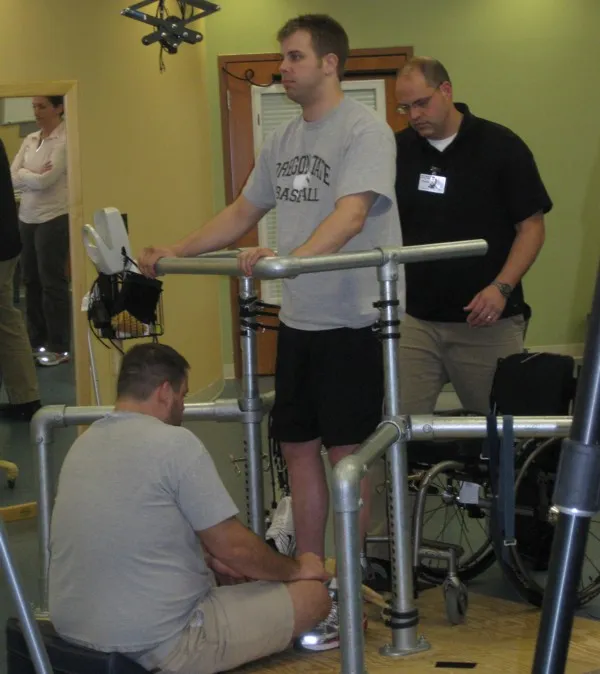
A technology called epidural spine stimulation, which involves implanting a device that sends electrical signals to the spine, has proven especially effective at restoring movement to four paralyzed people. All four of the patients in the pilot trial had complete motor spinal cord injuries, meaning the nerves to their muscles were severed. But two of the men also had complete motor and sensory injuries, so they lacked any sensation in the parts of their bodies below the level of their injuries.
The device "reawakens the spinal cord and reminds of its potential," Matthew Reeve told Live Science. "Right now, it's the most promising therapy today."
In 2009, a man who was paralyzed from the chest down after a car accident underwent surgery to implant the device that electrically stimulated his spinal cord, which was no longer receiving signals from his brain in the parts of his body below the injury. With the device, he was able to stand and take steps with assistance, researchers from the University of Louisville reported in 2011.
Get the world’s most fascinating discoveries delivered straight to your inbox.
Since then, three more people who had been paralyzed for more than two years have had epidural spine stimulators implanted. All four individuals were able to flex their toes, ankles and knees again, scientists reported in April. The patients also saw improvements in bladder, bowel and sexual function. [5 Crazy Technologies That Are Revolutionizing Biotech]
One of those patients was Kent Stephenson of Mount Pleasant, Texas. Stephenson suffered a complete motor and spinal cord injury in a Motocross accident, leaving him unable to move or feel anything from the waist down.
"When I came out of the hospital, they basically gave me a bag of medicine, a stretching routine and a wheelchair — and that was it," Stephenson said. But now, having the spinal stimulation device "gives me the ability to take a step forward and overcome my paralysis," he said.
Today, the Christopher and Dana Reeve Foundation announced a new campaign, called The Big Idea, to raise $15 million to expand the clinical trial of the device to an additional 36 paralyzed patients.
But it's not the only technology showing real promise for treating paralysis.
Brain-computer interfaces
Devices called brain-computer interfaces (BCIs) — which link the brain to a computer or external device, such as a prosthetic limb — have also made great leaps in treating paralysis in the years since Christopher Reeve's death.
By the early 2000s, researchers at Duke University and the University of Pittsburgh independently developed systems that allowed a monkey to control a prosthetic limb with its mind. An array of electrodes implanted in the monkey's brain recorded signals from an area that controls the animal's arm, and a computer used those signals to move a prosthetic arm.
In 2005, a group at Brown University implanted a similar system (known as BrainGate) into the first human patient, who was paralyzed from the neck down. Using this system, the patient was able to move a cursor on a computer screen, and open and close a prosthetic arm. Since then, several more paralyzed patients have tested the BrainGate system. In 2012, one of them used it to operate a prosthetic arm to take a drink.
Meanwhile, other efforts have focused on developing technology to reanimate the patient's own body.
Exoskeletons
While Tony Stark's "Ironman" suit doesn't exist in reality, powered exoskeletons have been making their way into paralysis rehabilitation for years now.
Attempts to make wearable robotic suits date back to the 1970s, but advancements in motor, battery and sensor technology have made such suits a real promise in paralysis rehabilitation.
In 2010, Richmond, California-based Berkeley Bionics (now called Ekso Bionics) introduced an exoskeleton called eLEGS, short for Exoskeleton Lower Extremity Gait System (now called Ekso). Battery-powered motors drive the legs, and sensors in the device trigger it to take steps when the user shifts his or her weight. In 2013, eLEGSentered clinical trials at four sites around the country, but it is not yet commercially available, its makers say.
Researchers at Vanderbilt University in Nashville created the Indego Exoskeleton, which has allowed people with paralysis to stand upright, sit and even walk. They began testing the device in 2010 at a rehab center in Atlanta. Parker Hannifin Corp., a Mayfield Heights, Ohio-based company that makes motion and control technologies, introduced a commercial version of the Indego Exoskeleton in June.
Meanwhile, the University of Tsukuba in Japan and the robotics company Cyberdyne developed the Hybrid Assistive Limb(HAL). They started testing the suite on paralyzed people in 2012 at hundreds of Japanese medical institutions. In August 2013, the European Commission certified HAL for use in Europe, making it the world's first clinically certified medical treatment robot.
Recently, some researchers have even attempted to combine brain-computer interfaces and exoskeletons. In a highly anticipated demonstration at the World Cupin Brazil in June, a young paraplegic man in a brain-controlled exoskeleton kicked a soccer ball during the opening ceremony. The man wore a cap of electrodes that recorded signals from his brain and sent them to a laptop-size computer worn on his back that triggered the exoskeleton to execute the kick. However, the technology does not yet enable paralyzed individuals to walk again under their own brain control.
Curing paralysis may still be a distant dream, but Matthew Reeve said his father would have been "incredibly excited" by all that's been achieved in the past decade.
"We're one step closer to his vision of a world of empty wheelchairs," he said.
Follow Tanya Lewis on Twitter and Google+. Follow us @livescience, Facebook & Google+. Original article on Live Science.
