















Mountains May Suck Up Carbon Better Than Thought

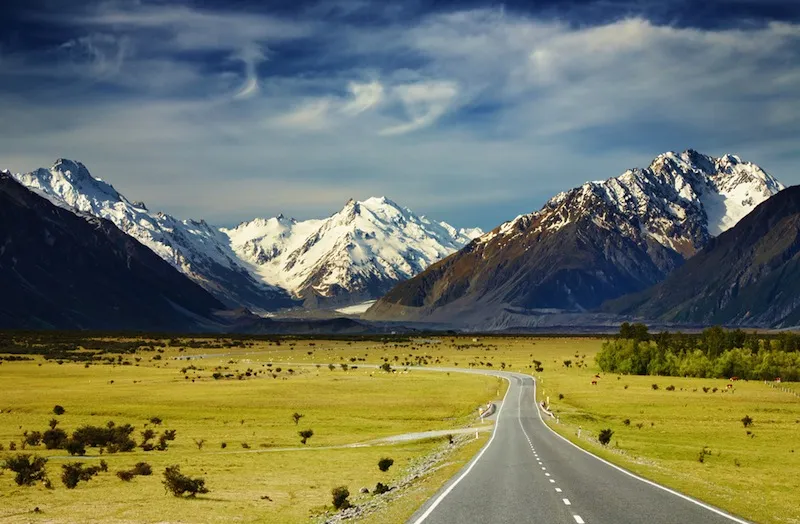
The rocks atop steep mountains can break down into soil far quicker than previously thought, new research shows. Given that soil is involved in removing carbon dioxide from the atmosphere, the results suggest that mountains may have the potential to influence global climate, researchers say.
Previous research had suggested there's a "speed limit" to the rate of new soil production and weathering on rapidly eroding mountain ranges. To test if this speed limit can be broken, researchers analyzed soil samples from the western Southern Alps of New Zealand. Through tectonic activity, these mountains uplift, or grow, faster than most others on Earth — this phenomenon also erodes rocks and exposes new soil that is able to extract carbon dioxide from the atmosphere through a process called chemical weathering. (Carbon dioxide is a greenhouse gas that's able to block Earth's heat from escaping into space, resulting in a rise of global average temperatures).
The scientists found the rate of soil production and weathering on these mountains was more than twice as high as was thought possible. The Southern Alps, and potentially other mountain ranges, may be able to act as so-called carbon sinks that help suck carbon dioxide from the atmosphere, the research, detailed today (Jan. 16) in an issue of the journal Science Express, suggests.
"Our results suggest that in one of the most rapidly eroding mountains on Earth, the weathering rates can be quite high in the soil," study author Isaac Larsen, a planetary scientist at the California Institute of Technology, told LiveScience. "This means that mountains have the potential to influence the climate at the global scale." [50 Interesting Facts About the Earth]
A potential carbon sink
When tectonic plates collide, the deformation of the Earth's crust causes mountains to form or grow. This uplift activity results in rapid erosion, whereby large rocks break into smaller pieces, increasing the overall surface area that's available for chemical weathering to act upon.
The chemical weathering of soil begins when atmospheric carbon dioxide dissolves in water molecules in the air, resulting in carbonic acid. The carbonic acid then reacts with the silicate minerals in the rock fragments and soil to produce calcium ions and the compound bicarbonate, among other things. The calcium and bicarbonate make their way into rivers and the ocean, where animals, including clams, mussels and coral, use them to create their strong shells and bones. After these animals die, their shells and bones are broken down by waves and settle on the ocean floor, where they eventually become limestone.
Get the world’s most fascinating discoveries delivered straight to your inbox.
In effect, the soil atop mountains helps to trap atmospheric carbon dioxide in the limestone.
Based on these processes, it would appear that mountains undergoing active uplift could serve as effective carbon sinks, but this idea has been debated. Based on soil measurements taken from a handful of mountains across the globe, researchers had predicted there's a limit to how quickly chemical weathering can occur on mountains, and that limit is related to the uplift and erosion on the mountain.
On the one hand, if there's little uplift there will be low rates of erosion and not enough new soil available to sustain weathering. On the other hand, as the rates of uplift and erosion increase, the surface movement will actually remove the soil before weathering has enough time to take place, the thinking goes.
However, "none of the measurements were made on the most rapidly uplifting mountains on Earth," Larsen said.
Revealing how fast soil is made
Larsen and his team decided to measure the soil production and weathering rates across New Zealand's Southern Alps. These mountains, Larsen explained, experience rapid vertical uplift and erosion of about 0.4 inches (1 centimeter) per year.
The team first collected dozens of pounds of soil from several sites in the Southern Alps. They then measured the soil concentration of Beryllium-10, an isotope (or variant of a chemical element) that's only produced in the dirt when high-energy cosmic rays bombard the Earth's surface.
"By measuring the concentration of the isotope, we can infer how rapidly bedrock is being transformed into soil," Larsen said. That is, if there's a lot of Beryllium-10 in the soil, it would indicate that the material spent a long time on the surface and the soil production rate is low. But if there are low levels of the isotope, it means that the surface soil is quickly being renewed. [Infographic: Tallest Mountain to Deepest Ocean Trench]
"We found low concentrations of Beryllium-10, and when we worked through all the calculations, we found soil production rates that are between a tenth of a millimeter a year and 2.5 millimeters a year," Larsen said. "The highest rates in the Southern Alps are more than a factor of two greater than the highest rates that had been measured previously [on other mountains]."
What's more, the scientists found that the soil weathering rates didn't decline as erosion from uplift increased, as other research had suggested would be the case — the weathering rates actually increased as erosion increased.
The team thinks that regional climate has a lot to do with their results. The Southern Alps have a lot of dense vegetation and weak bedrock, due to a high average rainfall of 33 feet (10 meters) per year. The vegetative roots likely pry into, and physically break down, the bedrock that has been fractured during mountain growth. Additionally, the vegetation may enhance the weathering of the rocks by making the soil weakly acidic. The wet environment may also prevent the mountain surfaces from becoming stripped of its new soil during uplift.
The same processes may be occurring in other steep, wet mountain ranges, such as the Himalayas and the mountains in Taiwan and Papua New Guinea, Larsen noted. "But it remains to be seen if there are comparable rates of soil production and weathering in other mountain ranges," he said, adding that further work on these rapidly uplifting mountains may reveal the fullinfluence of mountains and tectonic activity on the global climate.
Follow Joseph Castro on Twitter. Follow us @livescience, Facebook & Google+. Original article on LiveScience.
