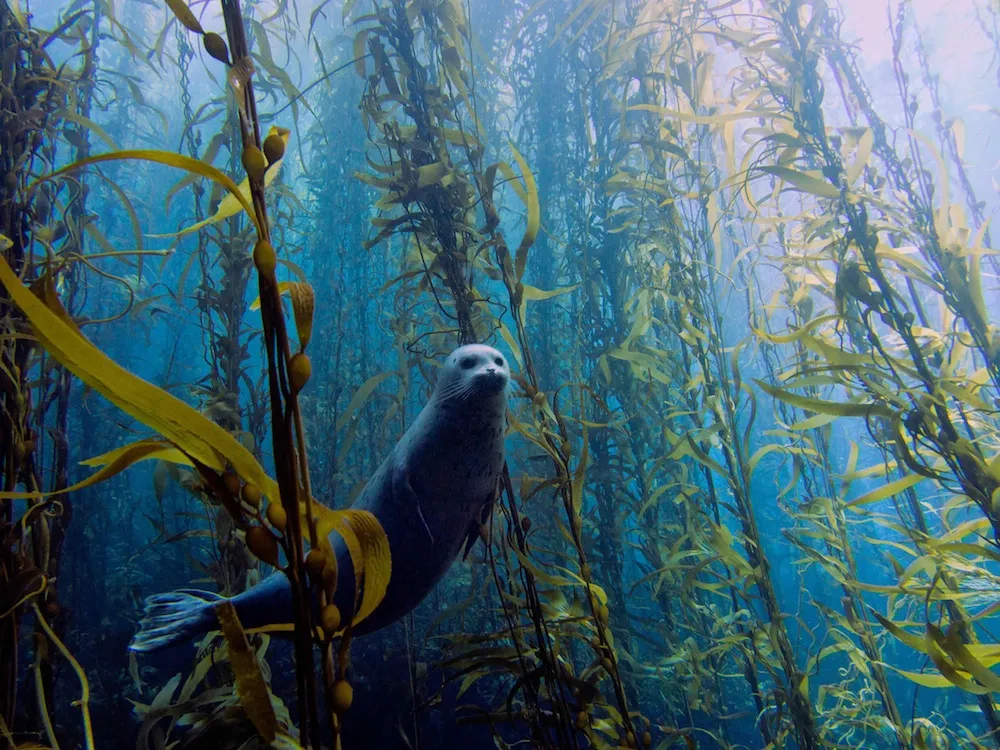
A harbor seal floats amidst a kelp forest in this dreamy image shot off the coast near San Diego, Calif. This image took best overall in the University of Miami's Rosenstiel School of Marine and Atmospheric Science 2013 underwater photography contest, which is open to amateur photographers everywhere.
An ethereal seal emerges from a forest of kelp in the winning photograph from the 2013 Annual Underwater Photography Contest held by the University of Miami Rosenstiel School of Marine & Atmospheric Science.
The haunting image was taken in California by amateur photographer Kyle McBurnie. Other 2013 honorees include colorful shrimp, crabs and fish, including a male jawfish incubating a clutch of eggs in his mouth near Riviera Beach, Fla.
The University of Miami contest is open to amateur photographers who earn no more than 20 percent of their income from photography. Awards are given for best macro shot (extreme close-up), best fish or marine animal portrait, best wide-angle shot and best overall. For snagging the best overall prize, McBurnie will receive a free Bahamas cruise. [See all the winning underwater shots]
In the wide-angle category, this shot at a shipwreck in the Red Sea wowed -- and scored first place.
(Image credit: Alex Tattersall, United Kingdom)
The winning harbor seal (Phoca vitulina) shot was taken at Cortex bank, which is near San Diego, Calif., but the contest spanned the globe. Beth Watson of Missouri snagged best macro shot for her striking image of a pink anemone shrimp perched on a pink anemone in Puerto Galera, Philippines. The second-place macro shot features a shrimp perched on two wormlike nudibranchs in Papua New Guinea, and the third place in that category again highlights the Philippines' anemones with a red-and-white image of a porcelain crab (Neopetrolisthes maculates) baring its claws from the safe haven of a similarly red-and-white anemone.
Finally, an electric-blue lionfish from Honduras netted first place in the portrait category, followed by a yellow-and-blue octopus from the Philippines and the father dusky jawfish from Florida.The wide-angle winner, snapped by Alex Tattersall of the United Kingdom, reveals a dizzying rainbow of fish, including a spiny lionfish, at a wreck in the Red Sea. Bottlenose dolphins in Hawaii and a colorful Red Sea reef took second and third in the wide-angle category.
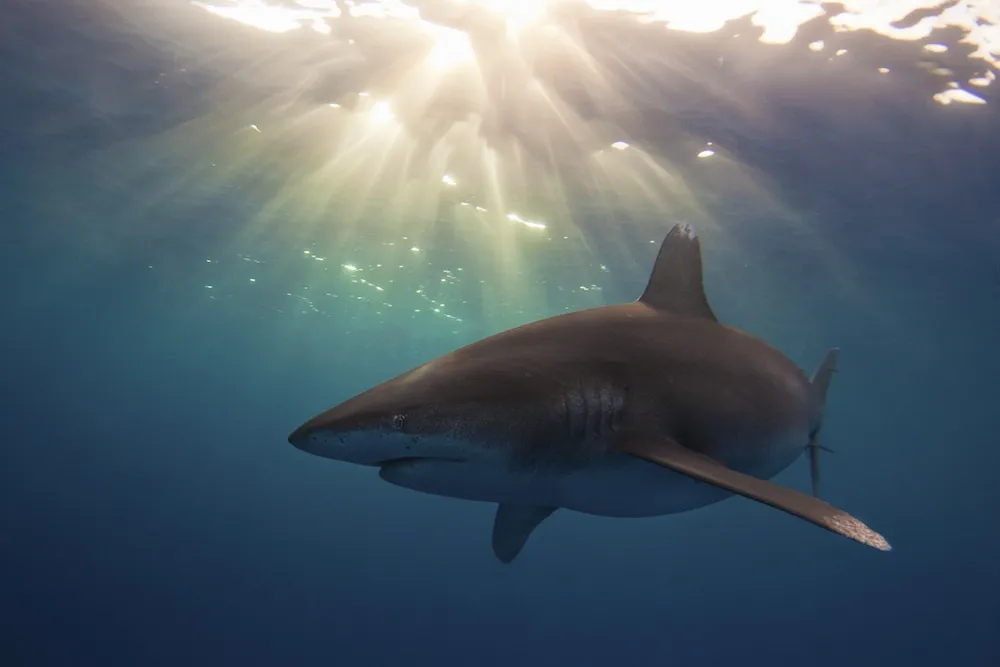
This oceanic white tip shark (Carcharhinus longimanus) near Cat Island, Bahamas took third place in the University of Miami's 2013 underwater photography contest, student division.
(Image credit: Austin Gallagher, Florida)
The contest also awards students for stunning images. This year, Laura Rock of Florida took first in the student category for an amazing close-up of a grouper (Epinephelus itajara) during spawning. Rock also took second for an image of a hammerhead shark in the Bahamas. A shark rounded out the top three student photos, as well, with Austin Gallagher's sunlit image of an oceanic white tip shark (Carcharhinus longimanus) cruising near Cat Island in the Bahamas.
Previous contest winners have included colorful sea slugs, transparent fish and crabs that carry around stinging sea anemones as weapons.
Sign up for the Live Science daily newsletter now
Get the world’s most fascinating discoveries delivered straight to your inbox.
Stephanie Pappas is a contributing writer for Live Science, covering topics ranging from geoscience to archaeology to the human brain and behavior. She was previously a senior writer for Live Science but is now a freelancer based in Denver, Colorado, and regularly contributes to Scientific American and The Monitor, the monthly magazine of the American Psychological Association. Stephanie received a bachelor's degree in psychology from the University of South Carolina and a graduate certificate in science communication from the University of California, Santa Cruz.