













Could a 9.0 Earthquake Happen In the United States?

A massive earthquake on par with the recent catastrophic seismic event in Japan could happen in two places in the United States, scientists say.
Geophysicists estimate that the Cascadia Subduction Zone, an intersection of tectonic plates just off the northwestern coast that stretches from the northern tip of California up to Canada, is capable of generating an earthquake with a magnitude as high as a 9.0 .
The last time the area shook that hard was 300 years ago. "There were hardly any people living on the Pacific Northwest Coast in 1700," said Heidi Houston, a seismologist at the University of Washington's Department of Earth & Space Sciences. "But it generated a huge tsunami that traveled to Japan and destroyed coastal villages there. The Japanese records show that the causative earthquake could only be our Cascadia Subduction Zone and it had to have been a magnitude-9.0."
By analyzing sedimentary deposits in low-lying areas along the coast, paleoseismologists have determined that large tsunamis (almost definitely produced by large earthquakes) strike the Pacific Northwest about every 500 years, give or take 200 years. Because the last one happened in 1700, "that means sometime in the next 400 years it will happen again," Houston told Life's Little Mysteries.
Scientists aren't able to provide a more specific time frame than that. They know what conditions must be present in an area to lead to massive earthquakes, but, according to Nathan Bangs, a geophysicist at the University of Texas, "it's hard to do useful predictions."
"The low-lying areas have deposits that give a record of repeated history of tsunami inundations, and how big they were. That means you may know the likelihood on the order of hundreds of years, but it doesn't give the likelihood in the next few years," Bangs explained.
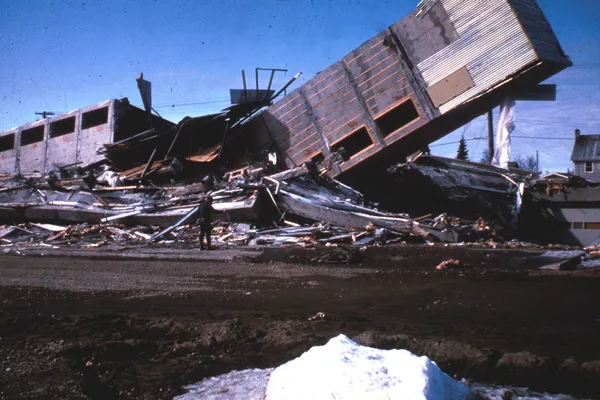
A 9.0 earthquake is also possible in Alaska, the most earthquake-prone state in the U.S. In 1964, the Aleutian fault separating the Pacific and North American plates ruptured near the city of Anchorage, resulting in a 9.2-magnitude earthquake the second largest ever recorded on a seismograph.
Get the world’s most fascinating discoveries delivered straight to your inbox.
The San Andreas Fault, commonly perceived to be more dangerous than the Cascadia Fault because of the proximity of several major California coastal cities, is not actually capable of generating a 9.0-magnitude earthquake. "The biggest one there would be just under 8.0," said Houston.
- How Are Earthquakes Measured?
- The 'Supermoon' Did Not Trigger Japan's Quake
- In Pictures: Japan Earthquake and Tsunami
Got a question? Send us an emailThis e-mail address is being protected from spambots. You need JavaScript enabled to view it This e-mail address is being protected from spambots. You need JavaScript enabled to view it This e-mail address is being protected from spambots. You need JavaScript enabled to view it This e-mail address is being protected from spambots. You need JavaScript enabled to view it This e-mail address is being protected from spambots. You need JavaScript enabled to view it This e-mail address is being protected from spambots. You need JavaScript enabled to view it This e-mail address is being protected from spambots. You need JavaScript enabled to view it This e-mail address is being protected from spambots. You need JavaScript enabled to view it This e-mail address is being protected from spambots. You need JavaScript enabled to view it This e-mail address is being protected from spambots. You need JavaScript enabled to view it This e-mail address is being protected from spambots. You need JavaScript enabled to view it This e-mail address is being protected from spambots. You need JavaScript enabled to view it This e-mail address is being protected from spambots. You need JavaScript enabled to view it This e-mail address is being protected from spambots. You need JavaScript enabled to view it This e-mail address is being protected from spambots. You need JavaScript enabled to view it This e-mail address is being protected from spambots. You need JavaScript enabled to view it This e-mail address is being protected from spambots. You need JavaScript enabled to view it This e-mail address is being protected from spambots. You need JavaScript enabled to view it This e-mail address is being protected from spambots. You need JavaScript enabled to view it This e-mail address is being protected from spambots. You need JavaScript enabled to view it This e-mail address is being protected from spambots. You need JavaScript enabled to view it and we'll crack itThis e-mail address is being protected from spambots. You need JavaScript enabled to view it . Follow Natalie Wolchover on Twitter @nattyover

Natalie Wolchover was a staff writer for Live Science from 2010 to 2012 and is currently a senior physics writer and editor for Quanta Magazine. She holds a bachelor's degree in physics from Tufts University and has studied physics at the University of California, Berkeley. Along with the staff of Quanta, Wolchover won the 2022 Pulitzer Prize for explanatory writing for her work on the building of the James Webb Space Telescope. Her work has also appeared in the The Best American Science and Nature Writing and The Best Writing on Mathematics, Nature, The New Yorker and Popular Science. She was the 2016 winner of the Evert Clark/Seth Payne Award, an annual prize for young science journalists, as well as the winner of the 2017 Science Communication Award for the American Institute of Physics.