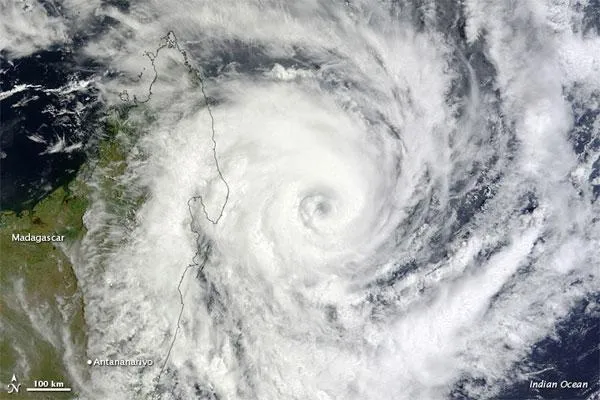
Tropical Cyclone Hits Madgascar
Get the world’s most fascinating discoveries delivered straight to your inbox.
You are now subscribed
Your newsletter sign-up was successful
Want to add more newsletters?
Delivered Daily
Daily Newsletter
Sign up for the latest discoveries, groundbreaking research and fascinating breakthroughs that impact you and the wider world direct to your inbox.
Once a week
Life's Little Mysteries
Feed your curiosity with an exclusive mystery every week, solved with science and delivered direct to your inbox before it's seen anywhere else.
Once a week
How It Works
Sign up to our free science & technology newsletter for your weekly fix of fascinating articles, quick quizzes, amazing images, and more
Delivered daily
Space.com Newsletter
Breaking space news, the latest updates on rocket launches, skywatching events and more!
Once a month
Watch This Space
Sign up to our monthly entertainment newsletter to keep up with all our coverage of the latest sci-fi and space movies, tv shows, games and books.
Once a week
Night Sky This Week
Discover this week's must-see night sky events, moon phases, and stunning astrophotos. Sign up for our skywatching newsletter and explore the universe with us!
Join the club
Get full access to premium articles, exclusive features and a growing list of member rewards.
Tropical Cyclone Bingiza made landfall on Madagascar on Feb. 14, 2011.
The U.S. Navy's Joint Typhoon Warning Center (JTWC) reported that, as of about noon Madagascar time on Feb. 14, Bingiza had maximum sustained winds of 98 mph (155 kilometers per hour) and gusts up to 120 mph (195 kph).
NASA's Terra satellite captured this image of Bingiza at 10:00 a.m. local time on Feb. 13, 2011. In the image, Bingiza's eye approaches northern Madagascar, and a spiral arm grazes Antananarivo.
Although Bingiza would weaken somewhat over land, the storm was expected to re-strengthen after passing over northern Madagascar , thanks to high sea surface temperatures, according to a NASA statement. The JTWC forecast that, on the western side of Madagascar, the storm would travel southward, roughly tracing the island's west coast.
Get the world’s most fascinating discoveries delivered straight to your inbox.