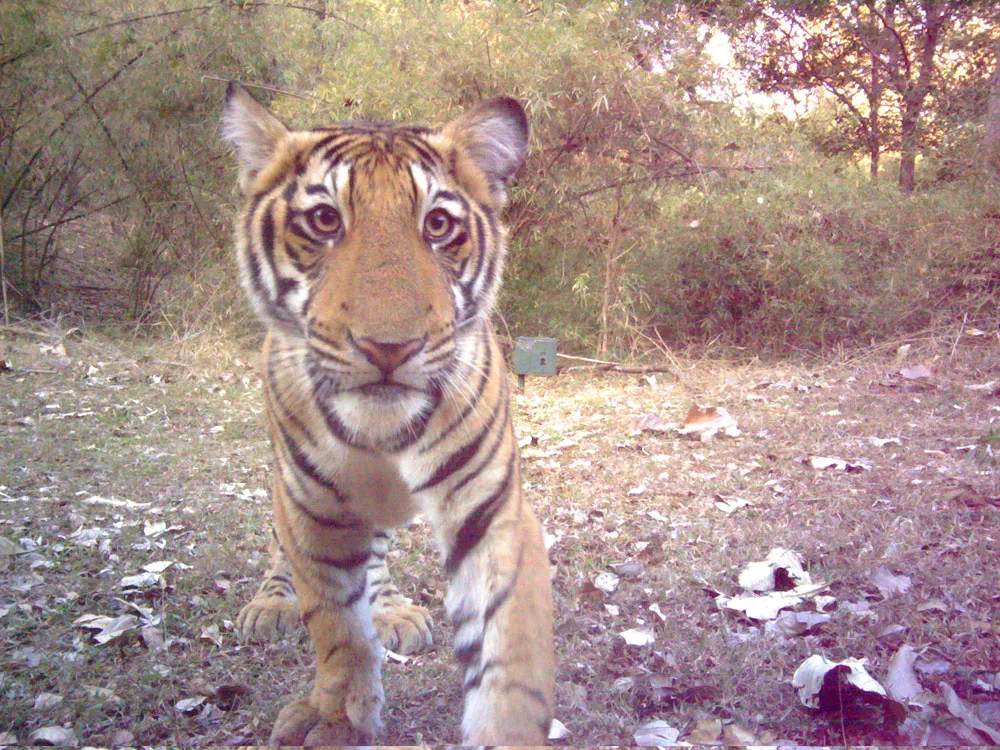
Camera Trap Snaps Curious Tiger Cub
Get the world’s most fascinating discoveries delivered straight to your inbox.
You are now subscribed
Your newsletter sign-up was successful
Want to add more newsletters?
Delivered Daily
Daily Newsletter
Sign up for the latest discoveries, groundbreaking research and fascinating breakthroughs that impact you and the wider world direct to your inbox.
Once a week
Life's Little Mysteries
Feed your curiosity with an exclusive mystery every week, solved with science and delivered direct to your inbox before it's seen anywhere else.
Once a week
How It Works
Sign up to our free science & technology newsletter for your weekly fix of fascinating articles, quick quizzes, amazing images, and more
Delivered daily
Space.com Newsletter
Breaking space news, the latest updates on rocket launches, skywatching events and more!
Once a month
Watch This Space
Sign up to our monthly entertainment newsletter to keep up with all our coverage of the latest sci-fi and space movies, tv shows, games and books.
Once a week
Night Sky This Week
Discover this week's must-see night sky events, moon phases, and stunning astrophotos. Sign up for our skywatching newsletter and explore the universe with us!
Join the club
Get full access to premium articles, exclusive features and a growing list of member rewards.
Cats, whether house-size or larger, are known for their curiosity. A tiger cub in India's Bhadra Tiger Reserve was no exception, as it was photographed inspecting a remote camera set up in the park to monitor its species.
The cub is estimated to be about four to five months old, according to a release from the Wildlife Conservation Society (WCS), which conducts animal surveys in the area and helped place the camera that captured the young tiger's image. A second camera can be seen in the background of the picture.

The Bhadra reserve stands as an example of tiger conservation success, the WCS notes, with their surveys showing that tiger numbers are rising. The cameras the group places help them identify tigers by their stripe patterns, which are unique to each animal.
Local conservationists have joined the WCS to push for more protections in the reserve, as well as opposing forest exploitation, illegal settlements and other development projects that could damage the habitat of the tigers and their prey, the group said in the statement. An increase in the tigers' prey has also contributed to the tigers' own increasing numbers.
There are six surviving subspecies of tiger and they range from being listed as endangered or critically endangered by the International Union for Conservation of Nature. Tiger numbers have decreased by about 95 percent over the past century, with only about 3,200 tigers thought to exist in the wild.
Follow Andrea Thompson @AndreaTOAP, Pinterestand Google+. Follow OurAmazingPlanet @OAPlanet, Facebook and Google+. Original article at LiveScience's OurAmazingPlanet.

Get the world’s most fascinating discoveries delivered straight to your inbox.

Andrea Thompson is an associate editor at Scientific American, where she covers sustainability, energy and the environment. Prior to that, she was a senior writer covering climate science at Climate Central and a reporter and editor at Live Science, where she primarily covered Earth science and the environment. She holds a graduate degree in science health and environmental reporting from New York University, as well as a bachelor of science and and masters of science in atmospheric chemistry from the Georgia Institute of Technology.