













Fastest Evolving Creature is 'Living Dinosaur'

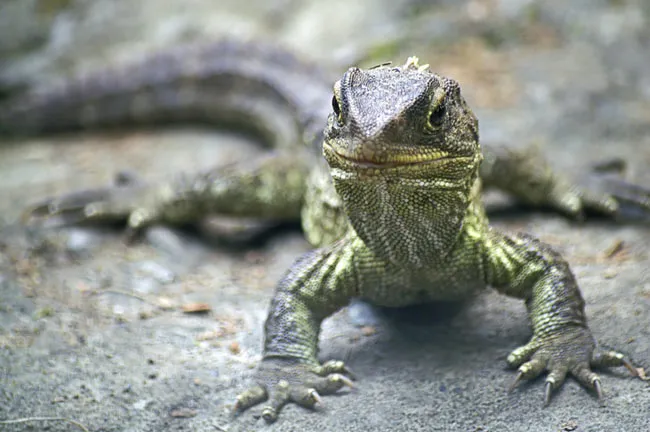
Scientists have pinned down the fastest-known evolving animal — a "living dinosaur" called a tuatara. The tuatara, Sphendon punctatus, resembles a lizard and is found only in New Zealand. It is the only surviving member of a reptilian order Sphehodontia that lived alongside early dinosaurs and separated from other reptiles 200 million years ago in the Upper Triassic period.
To make the estimate of evolutionary speed, researchers recovered DNA sequences from the bones of ancient tuatara. The team found that although tuatara have remained largely unchanged physically over very long periods of evolution, they are evolving — at a DNA level — faster than any other animal yet examined.The results will be detailed in the March issue of the journal Trends in Genetics.
"What we found is that the tuatara has the highest molecular evolutionary rate that anyone has measured," said researcher David Lambert from the Allan Wilson Centre for Molecular Ecology and Evolution in New Zealand.
Many scientists have thought that molecular evolution would be fastest in animals whose physical form, or morphology, also evolved swiftly. The tuatara finding suggests otherwise, that there is no relationship between the two rates.
"Of course we would have expected that the tuatara, which does everything slowly — they grow slowly, reproduce slowly and have a very slow metabolism — would have evolved slowly," Lambert said. "In fact, at the DNA level, they evolve extremely quickly."
The rate of evolution for Adélie penguins, which Lambert and his team have studied in the Antarctic for many years, is slightly slower than that of the tuatara. The tuatara rate is significantly faster than for other animals that have been studied, including the lion, ox, horse and the now-extinct cave bear.
Lambert says the finding will be helpful in terms of future study and conservation of the tuatara, and the team now hopes to extend the work to look at the evolution of other animal species.
Get the world’s most fascinating discoveries delivered straight to your inbox.
“We want to go on and measure the rate of molecular evolution for humans, as well as doing more work with moa and Antarctic fish to see if rates of DNA change are uncoupled in these species," Lambert said. "There are human mummies in the Andes and some very good samples in Siberia where we have some collaborators, so we are hopeful we will be able to measure the rate of human evolution in these animals too.”
- Dinosaur Quiz
- 10 Amazing Things You Didn't Know About Animals
- Snakes, Frogs and Lizards: The Best of Your Images
