














Tropical Storm Patty Forms, Not Expected to Stick Around

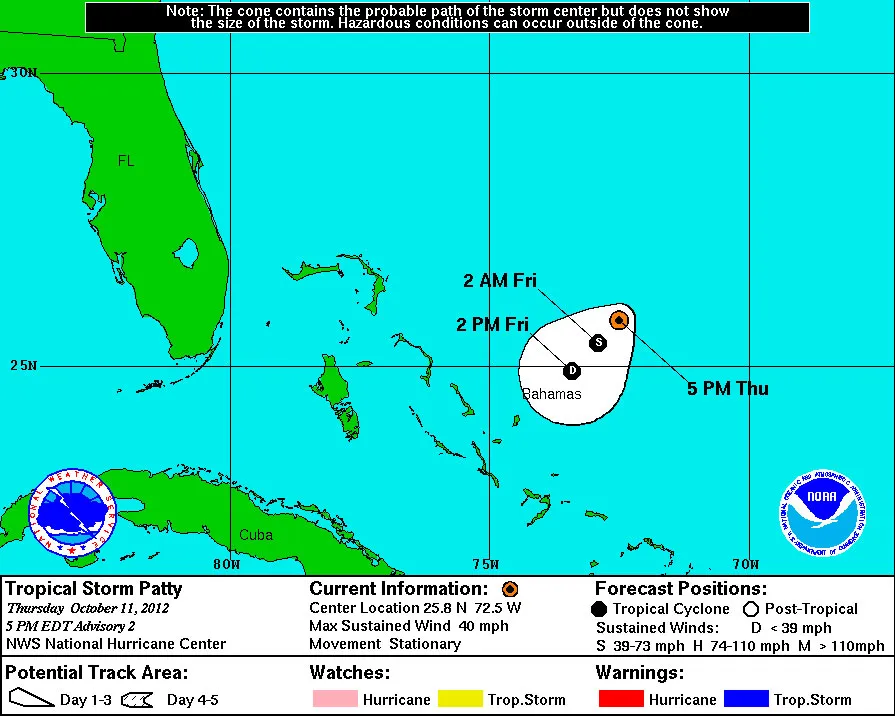
Tropical depression 16 has strengthened into Tropical Storm Patty, the 16th named storm of the 2012 Atlantic hurricane season.
But the storm is expected to have a short lifetime, with the National Hurricane Center (NHC) predicting it will weaken into a depression again by Friday afternoon.
Hurricane season is in its waning days as ocean temperatures cool and the Atlantic environment becomes less favorable for cyclone formation. The official end of the season is Nov. 30, though storms have been known to form late in the season and even after the official end date.
Tropical Depression 16 first formed early this morning (Oct. 11), and the NHC announced it had become a tropical storm in its 5 p.m. EDT update. The storm was dubbed Patty, the next name on the 2012 list of hurricane names. (Tropical cyclones, the generic name for tropical storms and hurricanes, are only named in the Atlantic basin once they achieve tropical storm strength. The names are picked by the World Meteorological Organization and are on a seven-year rotating cycle.)
Patty formed about a week after the most recent tropical storm in the Atlantic, Oscar, which was also short-lived, lasting for about two days.
"The tropical storm appears to be on borrowed time as there are a couple of factors coming together that should weaken the cyclone," the NHC forecast said. These factors include wind shear — when winds blow in different directions at different levels in the atmosphere and stymie storm development — and drier, more stable air could infiltrate the center of the storm, weakening the convection there.
Patty currently has maximum sustained winds of 40 mph (65 kph) and is located about 250 miles (400 kilometers) northeast of the Bahamas, according to the NHC.
Get the world’s most fascinating discoveries delivered straight to your inbox.
The amended hurricane season forecast put out in August anticipated 12 to 17 named storms would form during the season, with five to eight becoming hurricanes. Of the 16 storms that have formed, eight became hurricanes.
Nadine became a hurricane twice during its nearly 22 days over the Atlantic. It tied 1971's Ginger as the second longest-lasting tropical storm in the Atlantic basin. [50 Amazing Hurricane Facts]
Forecasters are watching another area of low pressure to the northeast of South America that they have given a 50 percent chance of becoming a tropical cyclone. If another named storm forms after Patty, it will be called Rafael.
This story was provided by OurAmazingPlanet, a sister site to Live Science.

Andrea Thompson is an associate editor at Scientific American, where she covers sustainability, energy and the environment. Prior to that, she was a senior writer covering climate science at Climate Central and a reporter and editor at Live Science, where she primarily covered Earth science and the environment. She holds a graduate degree in science health and environmental reporting from New York University, as well as a bachelor of science and and masters of science in atmospheric chemistry from the Georgia Institute of Technology.