FAIRBANKS, Alaska — I tagged along for two action-packed days last week with a group of researchers who were launching weather balloons to the edge of Alaska's northern lights. It was an experience I'll never forget.
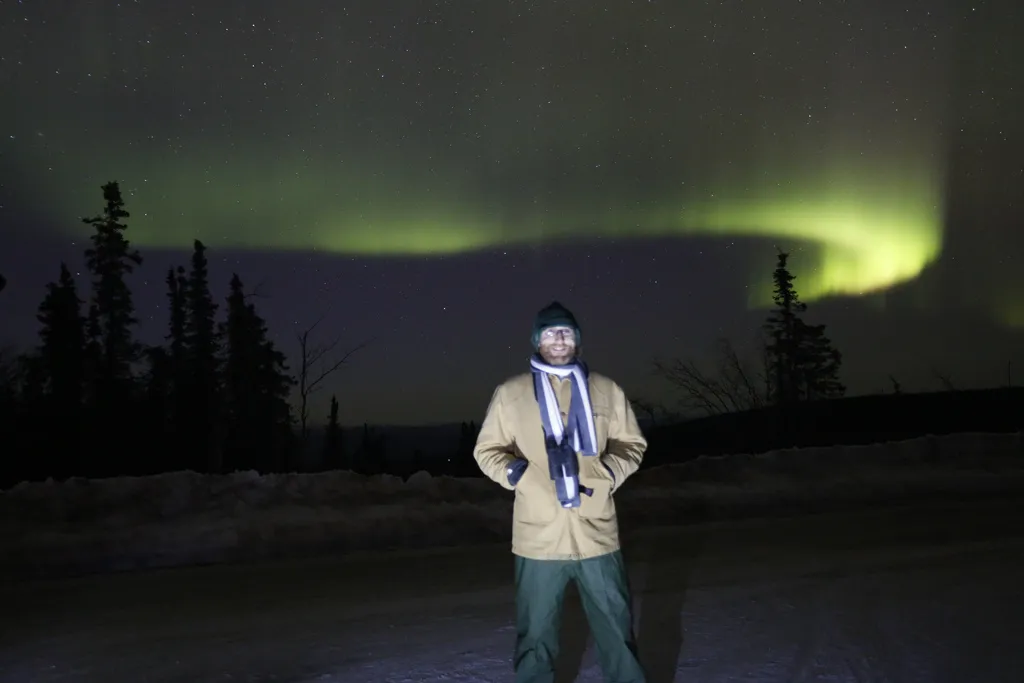
The northern lights themselves left the most indelible impression. I'd seen a brief flaring of the lights — also known as the aurora borealis — nearly 20 years ago, on a trip to Alaska with my dad. But during the early morning hours of April 11 and 12, the aurora at Murphy Dome mountain near Fairbanks put on lengthy shows that took my breath away.
Have You Ever Seen the Northern Lights or Southern Auroras?
Pictures of auroras like these can't do them justice, because they don't capture the ghostly movements that lend the lights much of their ethereal beauty. The lights are always flickering, turning and reconstituting in new and varied shapes and structures, like animals made of pure energy. [Photo Journal: Alaska Northern Lights Expedition]
I stood dumbstruck for hours with my head craned skyward, oblivious to the cold that was slowly turning my feet to ice.
Researchers prepare to launch an instrument-laden weather balloon toward Alaska's aurora on April 12, 2012 (at right is a radar facility).
(Image credit: Luke Kilpatrick)
Participating in the expedition, which is called Project Aether: Aurora, was a blast as well. I got to pick the brains of plasma physicists and watch as they prepped and then lofted instrument-laden balloons up toward the dancing auroras.
Project Aether: Aurora launched the weather balloons for several reasons. It wanted to photograph and study the northern lights from a unique perspective, and to this end, the balloons carried high-definition cameras and a variety of instruments and experiments.
Sign up for the Live Science daily newsletter now
Get the world’s most fascinating discoveries delivered straight to your inbox.
But the expedition also aims to inspire schoolkids all over the world to get more interested in science, technology and math, and ultimately to consider a career in these fields. The team hopes it captured stunning aurora footage that will help catch students' eyes, and it's working with GoPro — which provided the cameras for the expedition — to get these images out to the public.
Part of Project Aether: Aurora's pitch to kids is that science can be lots of fun, and the team hopes the sense of adventure permeating the expedition gets this message across.
I got a taste of some of this adventure myself. On the evening of April 11, for example, I snowshoed through the Alaskan backcountry for several hours with expedition researchers and educators to retrieve a balloon that had fallen back to Earth.
The team strapped on snowshoes to go get balloons and payloads that fell relatively close to a road. But roads can be few and far between in central Alaska, so Project Aether: Aurora also hopped aboard helicopters and snowmobiles to go after their more remote quarries.
The team also considered using dogsleds to go after some of the fallen payloads, and there was talk of letting us tag along on a dog-powered retrieval mission. The unseasonably warm weather scuttled that plan, thawing out a river that we would have needed to cross — but we still took an hourlong dogsled ride on April 11, just for fun.
That, like several other experiences during those whirlwind few days, was a first for me. I left Fairbanks early on April 12, a bit foggy-minded with sleep deprivation but exhilirated by the adventures I'd had and the things I'd learned. If I were making Project Aether: Aurora's pitch to kids, I'd say that's part of what being a scientist is all about.
This story was provided by SPACE.com, a sister site to LiveScience. You can follow SPACE.com senior writer Mike Wall on Twitter: @michaeldwall. Follow SPACE.com for the latest in space science and exploration news on Twitter @Spacedotcom and on Facebook.
Michael was a science writer for the Idaho National Laboratory and has been an intern at Wired.com, The Salinas Californian newspaper, and the SLAC National Accelerator Laboratory. He has also worked as a herpetologist and wildlife biologist. He has a Ph.D. in evolutionary biology from the University of Sydney, Australia, a bachelor's degree from the University of Arizona, and a graduate certificate in science writing from the University of California, Santa Cruz.