














First 'Alien Earth' May Be Found by 2014

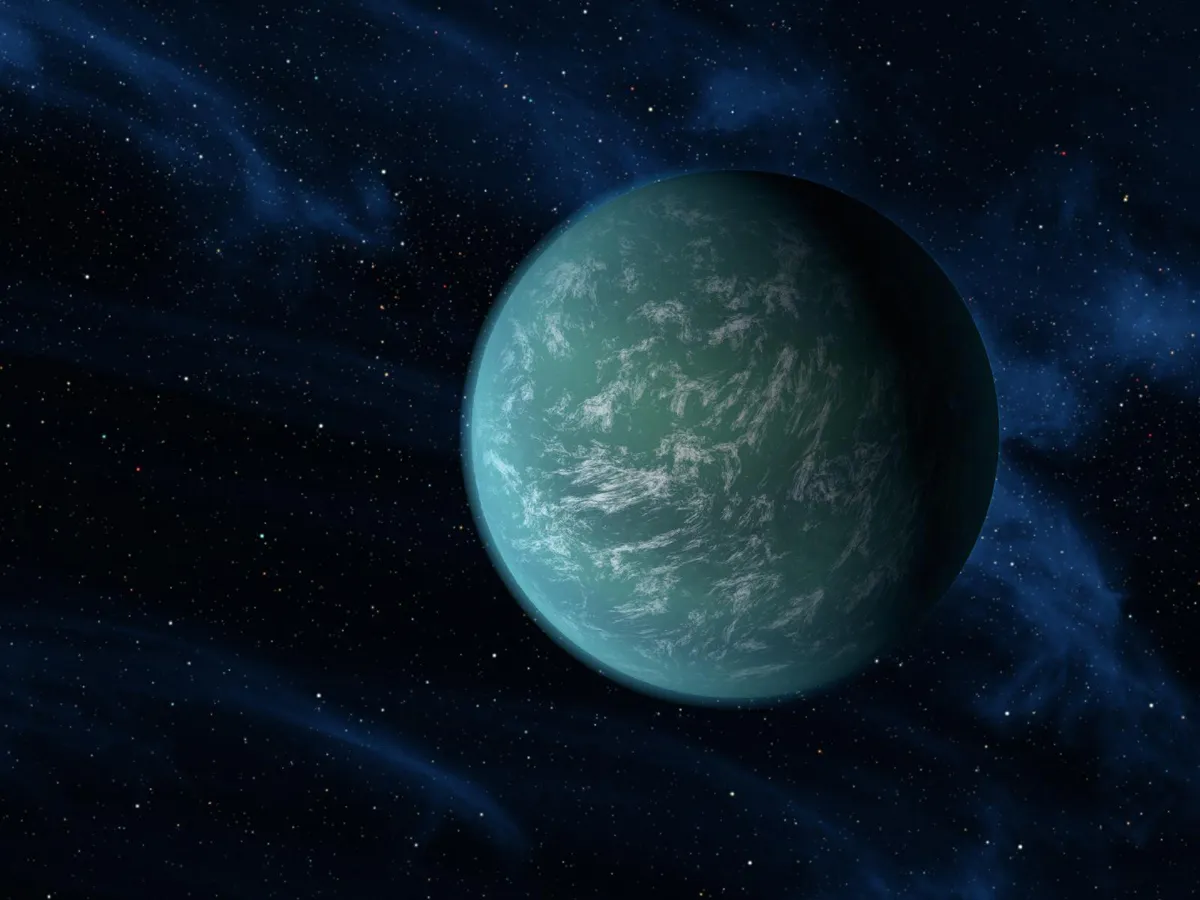
The first true "alien Earth" will likely be discovered in the next two years, a NASA scientist says.
Astronomers have found more than 750 alien planets to date, and NASA's Kepler Space Telescope has flagged 2,300 additional "candidates" awaiting confirmation by follow-up studies. This haul has not yet included an Earth-like exoplanet — one that's the size of our planet and orbits at the right distance from its star to support liquid water and, possibly, life as we know it.
But that could change soon, according to Shawn Domagal-Goldman, a researcher at NASA Headquarters in Washington, D.C. who specializes in exoplanet biology.
"I believe Kepler will find a 'Goldilocks planet' within the next two years," Domagal-Goldman said in a statement. "We'll be able to point at a specific star in the night sky and say 'There it is — a planet that could support life!'" [Video: How to Find Earth's Alien Twin]
Studying a 'Goldilocks planet'
Some NASA officials appear to share Domagal-Goldman's optimism, for the agency is already looking into ways to study alien Earths once they're found.
It's difficult to investigate such worlds directly, since faraway Earth-size planets are small and faint, their dim light almost completely drowned out by the bright glare of their parent stars. But researchers are confident that an indirect approach, called transit spectroscopy, can reveal a lot about Goldilocks worlds.
Get the world’s most fascinating discoveries delivered straight to your inbox.
This technique scrutinizes starlight that bounces off the atmosphere of an alien Earth on its way to our cosmic neighborhood. Such starlight carries a sort of fingerprint of the atmosphere, which astronomers can study to learn about the atmosphere's composition.
"The reflected light of an exoplanet tells its story," said Doug Hudgins, Kepler program scientist at NASA Headquarters.
New missions coming?
One new mission under consideration, called Finesse, uses the transit spectroscopy method. Finesse, which is short for "Fast INfrared Exoplanet Spectroscopy Survey Explorer," would measure the spectra of stars and their planets in two situations — once when the planet is in view, and again when it's hidden behind its star.
The mission would be able to separate the planet's dim light from the star's blazing glare, revealing the composition of the planet's atmosphere in the process, researchers said.
NASA is also considering an observatory named Tess (Transiting Exoplanet Survey Satellite). Supported in part by Google, this mission is designed to find alien planets in our local galactic neighborhood. Tess would study hundreds of stars within 50 light-years of Earth, close enough to study in some detail.
"With better detectors and instruments designed to block the glare of the parent stars, these next-generation telescopes could not only find a Goldilocks planet, but also tell us what its atmosphere is made of, what sort of cloud cover graces its skies, and maybe even what the surface is like — whether oceans cover part of the globe, how much land there is, and so on," Hudgins said.
Domagal-Goldman expects big finds, and big surprises.
"We've found so many unexpected things about planets that now I expect to be amazed," he said. "When we can study a Goldilocks planet, I believe we'll discover something revolutionary about how life interacts with a planetary environment. Nature is so much more diverse than we anticipated."
This story was provided by SPACE.com, a sister site to LiveScience. Follow SPACE.com for the latest in space science and exploration news on Twitter @Spacedotcom and on Facebook.
