













New Jurassic Salamander Is World's Oldest

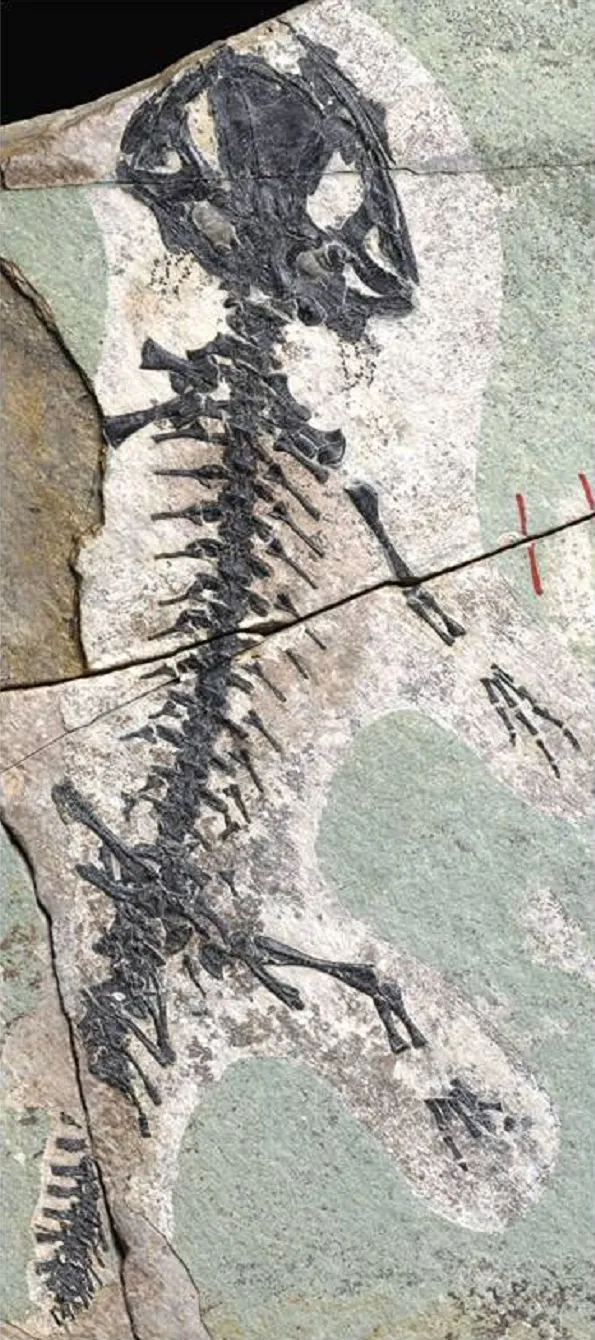
A newly discovered 157-million-year-old salamander is the oldest of its kind and would've swum with the aquatic beasts of the Jurassic.
The discovery supports the idea that this order diverged from other salamanders earlier than thought, the researchers said.
Six specimens of this new species, now called Beiyanerpeton jianpingensis, were discovered in the Tiaojishan Formation, in Liaoning Province, China. Some other salamander specimens discovered in the area are quite a bit smaller than B. jianpingensis, suggesting they are either juveniles or a smaller species. The salamander's scientific name comes from "beiyan," an ancient name for the area in which it was discovered, and "herpeton," the Greek word for creeping animal.
With a snout-to-pelvis length (excluding its tail) of 4 inches (10 centimeters), this salamander would've looked similar to modern salamanders. "All salamanders look alike in having short limbs and a normally developed tail," study researcher Ke-Qin Gao, of Peking University in Beijing, told LiveScience in an email. "In that respect, a reconstruction of our new salamander would look very much like salamanders we see today — you can recognize it as a salamander easily," with slight anatomical differences.
The fossil was found in the bed of an ancient lake, and because of the shape of its tail and other anatomical features, including gills, the researchers note that it probably lived in an aquatic habitat.
It is the oldest example of the suborder of salamanders called Salamandroidea, which are still alive today with about 557 living species. The previous record holder for oldest salamander is a fossil discovered in Spain, which dates to about 114 million years ago, meaning the new specimen extends the fossil record for salamanders by 40 million years.
"The previously known salamandroid from Spain is quite different from ours. They cannot be classified in the same family," Gao said. "In terms of evolution, ours is much older and much more primitive."
Get the world’s most fascinating discoveries delivered straight to your inbox.
The age of this fossil stacks up well with data from molecular experiments, which compared genes from modern Salamandroidea with a group of related salamanders, the Cryptobranchoidea, to determine how long ago the two groups diverged. Different experiments indicated different results: The two groups evolved into separate species either 140 million or 183 million years ago. The new example of Salamandroidea indicates the earliest date, 183 million years ago, is more likely.
The species is described today (March 12) in the journal Proceedings of the National Academy of Sciences.
You can follow LiveScience staff writer Jennifer Welsh on Twitter @microbelover. Follow LiveScience for the latest in science news and discoveries on Twitter @livescience and on Facebook.

Jennifer Welsh is a Connecticut-based science writer and editor and a regular contributor to Live Science. She also has several years of bench work in cancer research and anti-viral drug discovery under her belt. She has previously written for Science News, VerywellHealth, The Scientist, Discover Magazine, WIRED Science, and Business Insider.