













Ancient Radio Waves Hold Key to Universe's First Light

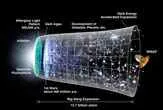
The early universe went through its own dark ages before the first stars formed and emitted the first light. Now astronomers are targeting this early epoch to try to learn precisely when that happened, and how.
So far, it has been difficult to learn much about the universe when it was so young, because any evidence is extremely distant and faint.
But a new study of ancient radio waves offers some hope that more answers could be around the corner.
Let there be light
The period when the universe's first stars formed and began shining their light is called the reionization epoch.
Astronomers' current best guess is that it was somewhere around a couple hundred million years after the Big Bang thought to have set the universe in motion 13.7 billion years ago. But researchers would like to refine that estimate considerably.
Before this epoch, the universe was made mostly of roughly uniform hydrogen gas.
Get the world’s most fascinating discoveries delivered straight to your inbox.
"We call that the dark ages because there wasn't really any light being generated," said astronomer Judd Bowman of Arizona State University, leader of the new study.
Then slight ripples in this gas caused denser areas to clump together under gravity, eventually accumulating enough mass to collapse into stars and begin nuclear fusion.
The radiation emitted by these first stars interacted with the leftover hydrogen gas around them, exciting the hydrogen atoms and knocking off their electrons, creating positively charged hydrogen ions. Hence the name reionization epoch.
Still, the details of how and when this happened are unknown.
"Nobody really knows when the first stars formed," Bowman told SPACE.com. "That's one of the questions we're trying to get at." [Top 10 Star Mysteries]
A new approach
To probe the universe's history, Bowman and his colleague Alan Rogers of the Massachusetts Institute of Technology custom-built a radio antenna called EDGES and deployed it at the Murchison Radio-astronomy Observatory in Western Australia.
Since identifying light from the earliest stars and galaxies is so difficult, the astronomers tried a different tack. They aimed their device to look instead for the hydrogen gas between the galaxies, which would have emitted a characteristic radio signal.
Then, they looked for signs of how this signal may have changed over time, due to the emergence of galaxies and stars that would have ionized the gas. Eventually, when all of the gas was ionized, the neutral hydrogen signal would be erased.
"Our experiment was designed to constrain whether or not that step was very fast," Bowman said. "We didn’t detect any change, which means it took longer than about 3 to 12 million years" for galaxies and stars to form and reionization to occur.
That measurement is in keeping with most models of the early universe, though it does help to rule out a few fringe theories. The real breakthroughs should come soon, when the scientists are able to refine their instrument design and look at a wider range of radio frequencies.
"Our result has not tested the mainstream theories yet," Bowman said. "We're getting our toe in the door."
The most important advance of this study, Bowman said, was to demonstrate that their method works.
The results are detailed in the Dec. 9 issue of the journal Nature.
- Photos: Amazing Galaxy Images
- Top 10 Star Mysteries
- After Big Bang Came Moment of Pure Chaos, Study Finds
This article was provided by SPACE.com, a sister site of LiveScience.com.
