













Brown Clouds Add to Global Warming

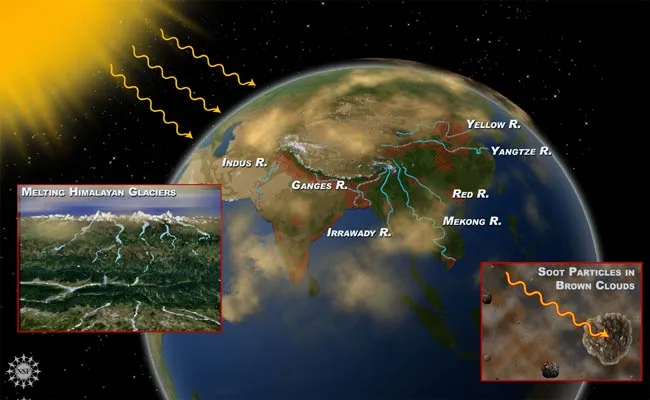
Pollution-filled "brown clouds" over the Indian Ocean could warm parts of the lower layers of Earth’s atmosphere as much as greenhouse gases do, a new study finds.
Aerosols, or tiny particles suspended in the air, make up clouds of pollution and are thought to have an overall cooling effect on the atmosphere as they scatter incoming light back out to space. Scientists suspect that this cooling effect could mitigate some of the warming caused by greenhouse gases.
But some aerosols, particularly soot, are very good at absorbing the sun's rays, and this absorption heats the layer of the atmosphere in which they sit.
How the heating from these aerosols compares to that from greenhouse gases has been largely unknown, but this new study, detailed in the Aug. 2 issue of the journal Nature, found that the warming from the two sources is comparable.
Brown clouds
During the six-month tropical dry season, soot and other aerosols waft over the Indian Ocean from Asia and form plumes of pollution known as "atmospheric brown clouds".
The researchers used unmanned aerial vehicles (UAVs) to measure the concentration of the aerosols over the ocean and how much heat they absorbed at different levels of the atmosphere.
Get the world’s most fascinating discoveries delivered straight to your inbox.
The first half of the study period saw little pollution and little atmospheric heating, but during the second half, the brown clouds rolled in and atmospheric heating increased by 50 percent.
Using these results, the researchers modeled the heating effects of brown clouds in the region from 1950 to 2000 and found that it was about the same as that caused by greenhouse gases.
Himalayas and megacities
This study shows that the regional influence of aerosols, not just the global average seen in estimates by the Intergovernmental Panel of Climate Change, may be very important, said Peter Pilewskie of the University of Colorado at Boulder, who was not involved with the study.
"And, interestingly, that influence could either enhance (warm, as we've seen in this study) or mitigate (cool) the expected warming by greenhouse gases," Pilewskie said in an email interview.
The overall warming trend caused by greenhouse gases and aerosols in the area have caused the lower atmospheric layer to warm by 0.25 degrees Celsius per decade—twice the rate of warming at the surface, Pilewskie said in an analysis of the study.
This warming has had enormous implications for the Himalayas, where warming has led to a rapid glacier melt.
"The large clouds of pollution in Asia absorb enough solar energy to have climatic impacts," Pilewskie said.
Pilewskie added that other studies are investigating the possible climatic effects of pollution plumes drifting off from megacities (those with 10 million people or more), though he noted that as fewer aerosols are emitted due to the development of cleaner combustion processes, the influence of aerosols is likely to diminish in the future.
- What's Your Environmental Footprint?
- Top 10 Surprising Results of Global Warming
- Image: Aerosols Create Cooling Effect

Andrea Thompson is an associate editor at Scientific American, where she covers sustainability, energy and the environment. Prior to that, she was a senior writer covering climate science at Climate Central and a reporter and editor at Live Science, where she primarily covered Earth science and the environment. She holds a graduate degree in science health and environmental reporting from New York University, as well as a bachelor of science and and masters of science in atmospheric chemistry from the Georgia Institute of Technology.