
 Live Science Plus


Simple Experiment Creates Surprising State of Matter

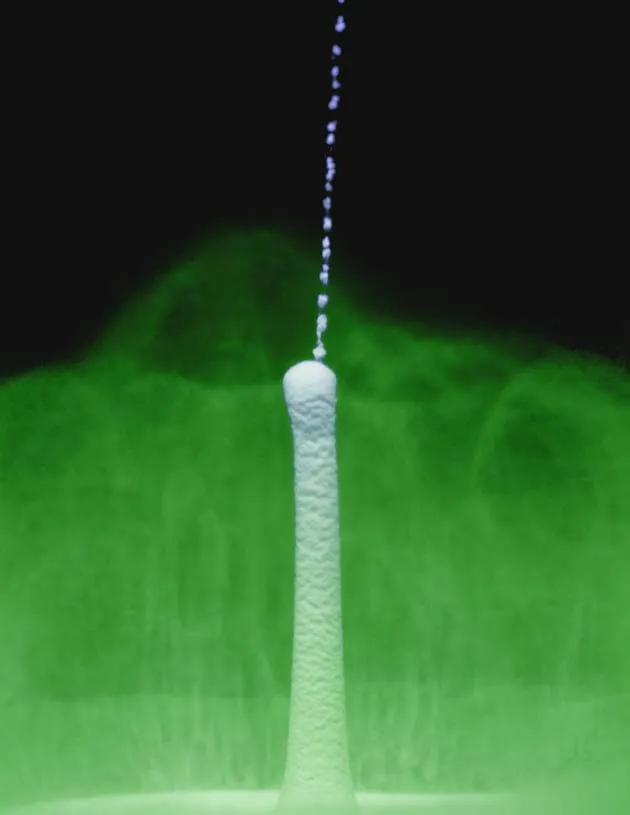
Here's a science experiment you can pretty much duplicate at home:
Physicists at the University of Chicago essentially dropped a marble into loosely packed sand, producing a jet of sand grains that briefly behaves like a special type of dense fluid.
They describe it as a novel state of matter.

"We're discovering a new type of fluid state that seems to exist in this combination of gas—air in this case—and a dense arrangement of particles," said lead researcher Heinrich Jaeger. "It's just a most amazing phenomenon."
How it works
Strange states of matter are sometimes created in super-cold conditions approaching absolute zero. Things get weird there. But this experiment was done at room temperature.
Images at top are from a high-speed video of a granular jet produced by the impact of a marble into sand at atmospheric pressure. Bottom row is a les impressive jet created at reduced pressure. Images courtesy of Heinrich Jaeger, University of Chicago
"The jet acts like an ultra-cold, ultra-dense gas, not in terms of ambient temperature, but in terms of how we define temperature via the random motion of particles," Jaeger explained. "Inside the jet there is very, very little random motion."
Get the world’s most fascinating discoveries delivered straight to your inbox.
Though announced yesterday, the phenomenon was first noted in 2001 in work by Sigurdur Thoroddsen and Amy Shen, who were then at the University of Illinois at Urbana-Champaign.
Jaeger encouraged his graduate student Andrew Flior to reproduce the experiment, and a group led by Detlef Lohse at the University of Twente in The Netherlands used high-speed video and computer simulations to suggest the jet was caused by gravity as material rushed in to fill the void left behind by the impacting object.
The researchers made X-ray images at 5,000 frames per second. They conclude that air compressed between the sand grains provides most of the energy to drive the jet, since the same experiment performed at artificially low air pressure does not produce a significant jet.
"The result is totally unexpected," said Lohse. "One would think that the effect of air would weaken the jet, but what is the case is just the opposite."
The jet is broken into two distinct segments, one solid and the other a stream of droplets.
"One of the biggest questions that we have still not solved is why this jet is so sharply delineated." Jaeger said. "Why are there these beautiful boundaries? Why isn't this whole thing just falling apart?"
You can do it
The research was funded by the National Science Foundation and the Department of Energy.
The basics of the experiment can be repeated at home, though without all the government funding and a fancy X-ray imager you probably won't get the full effect.
Pour a cup of powdered sugar into another container to ensure it is loosely packed, Jaeger explains. Drop a marble into the cup. "Once you drop that marble in there, you see that jet emerging, but you have to look fast."
The discovery is detailed in the December issue of the journal Nature Physics.

Robert is an independent health and science journalist and writer based in Phoenix, Arizona. He is a former editor-in-chief of Live Science with over 20 years of experience as a reporter and editor. He has worked on websites such as Space.com and Tom's Guide, and is a contributor on Medium, covering how we age and how to optimize the mind and body through time. He has a journalism degree from Humboldt State University in California.