













Heavier Monkey Moms Produce Higher Quality Breast Milk

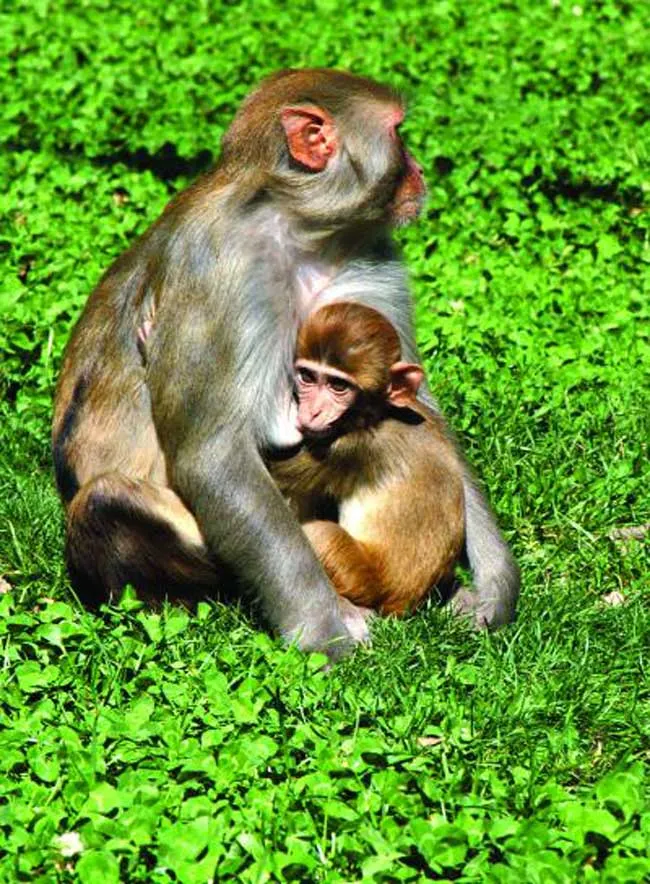
Heavier monkey moms that have given birth before produce higher quality breast milk, resulting in suckling infants that are more playful and confident than their pals, a new study finds.
The opposite was true for first-time monkey moms that weighed less: Their offspring were less confident and less active.
The breast milk might confer a reliable signal to infants about their environment, according to the researchers. The signal could then program an infant's behavior and temperament according to expectations of available resources, discouraging temperaments that prove risky when food is scarce.
The scientists studied rhesus macaques, a species in which the monkey moms are known to act much like humans toward their newborns.
They collected breast milk from 59 rhesus macaque moms living in an outdoor enclosure at the California National Primate Research Center at the University of California, Davis. The milk was collected when infants were 1 month old and again at 3.5 months.
Then, the team recorded the quantity of milk produced by each mother and the amount of sugars, proteins and fat the milk contained. These figures were combined to calculate the available milk energy generated by each mother and passed on to infants.
Milk from mothers that weighed more and had had previous pregnancies contained higher available energy when their infants were 1 month old than the milk of lighter, less experienced mothers.
Get the world’s most fascinating discoveries delivered straight to your inbox.
To find out the milk's effects on baby behavior, each infant at 3 to 4 months old was temporarily separated from its mother. During that time, researchers assessed the infants' behavior and temperament.
Infants whose mothers had higher levels of milk energy soon after their birth coped more effectively with the separation; they moved around more, explored more, and ate and drank more compared with the other infant monkeys. These infants that got higher-energy breast milk also showed greater confidence; they were more playful, curious and active than other infants.
Mothers and infants were reunited immediately after the experiment.
"This is the first study for any mammal that presents evidence that natural variation in available milk energy from the mother is associated with later variation in infant behavior and temperament," said lead study author Katie Hinde, an anthropologist at the California National Primate Research Center and the nutrition laboratory at the Smithsonian's National Zoo.
Hinde added, "Our results suggest that the milk energy available soon after birth may be a nutritional cue that calibrates the infant's behavior to environmental or maternal conditions."
The study was published in the Feb. 16 issue of the American Journal of Primatology.
