













Students Discover Clawed Dinosaur in China
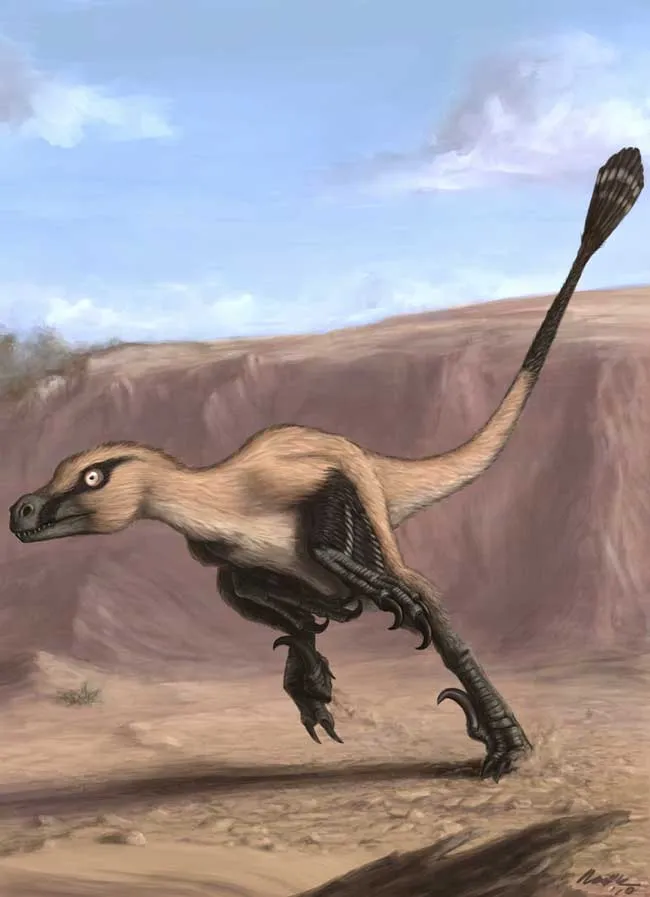
A claw sticking out of a cliff face in Mongolia, China, turned out to be the tip of the dinosaur – the skeleton of a 6-foot-long agile predator that preyed on its own kind.
"It was a total surprise that the whole skeleton was buried deeper in the rock," said doctoral student Jonah Choiniere of George Washington University, who along with graduate student Michael Pittman of University College London discovered the dinosaur remains during a 2008 field expedition.
Now called Linheraptor exquisitus, the dinosaur lived some 75 million years ago and is a relative of Velociraptor, a feathered, bipedal meat-eater.
With its spindly body proportions, about 6 feet long (1.8 meters) and 50 pounds (23 kilograms), Linheraptor would have been a fast, agile predator, the researchers suspect. Like other members of its family Dromaeosauridae, the dinosaur sported a large, curved claw on the foot that might have helped in capturing prey like horned dinosaurs.
The pair of doctoral students found the skeletal remains in rocks of the Wulansuhai Formation, part of a group of red sandstone rocks in Inner Mongolia, China. It is the fifth dromaeosaurid discovered in the rocks, which are famous for their preservation of uncrushed, complete skeletons.
"Jonah saw a claw protruding from the cliff face. He carefully removed it and handed it to me," Pittman said, adding, "I've always wanted to discover a dinosaur since I was a kid, and I've never given up on the idea. It was amazing that my first discovery was from a Velociraptor relative."
The find marks the first near complete skeleton of its kind to be found in the Gobi desert since 1972, and will help piece together the appearance of other closely related dinosaur species.
Get the world’s most fascinating discoveries delivered straight to your inbox.
The researchers, led by Xu Xing of the Chinese Academy of Sciences' Institute of Vertebrate Paleontology and Paleoanthropology, will publish their findings in the March 19 issue of the journal Zootaxa.
- 25 Amazing Beasts
- Images: Dinosaur Fossils
- Dinosaur Quiz: Test Your Smarts
Jeanna Bryner is managing editor of Scientific American. Previously she was editor in chief of Live Science and, prior to that, an editor at Scholastic's Science World magazine. Bryner has an English degree from Salisbury University, a master's degree in biogeochemistry and environmental sciences from the University of Maryland and a graduate science journalism degree from New York University. She has worked as a biologist in Florida, where she monitored wetlands and did field surveys for endangered species, including the gorgeous Florida Scrub Jay. She also received an ocean sciences journalism fellowship from the Woods Hole Oceanographic Institution. She is a firm believer that science is for everyone and that just about everything can be viewed through the lens of science.