













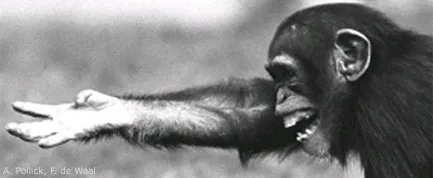
Our closest primate relatives, the bonobos and chimps, are more versatile when communicating with their hands, feet and limbs than with their facial expressions and voices. The finding, detailed in the April 30 issue of the journal for the Proceedings of the National Academy of Sciences, supports the notion that humans were communicating with sign language long before they were speaking, an idea known as the “gestural hypothesis.” Researchers at Emory University studying two groups of chimpanzees (34 animals) and two groups of bonobos (13 animals) observed 31 manual gestures and 18 facial/vocal signals. They found both species make similar use of facial/vocal signals, but manual gestures were more varied, both within and between species. For example, “a scream is a typical response for victims of intimidation, threat or attack,” said study team member Amy Pollick. “This is so for both bonobos and chimpanzees.” The message conveyed by a gesture, however, depended upon the social context in which it was used. A chimp in a fight, for example, might extend its hand toward another chimp in a plea for help, but the same gesture made toward a chimp with food signals a desire for a share. The findings offer clues to the origins of human language, the researchers say. Scientists think communication with body gestures is evolutionarily younger than facial expressions and vocalizations, since apes and humans gesture, but monkeys do not. According to the gestural hypothesis, our early ancestors could make noises using their throats and mouths, but true communication first took the form of hand gestures and a primitive sign language. As support of this idea, the researchers point out that the chimps and bonobos in their study appeared to have more control over their gestures than they did over their facial expressions or voices. This is still true to some extent for humans as well. “We have control over speech, but nonverbal things—such as our tone of voice when we are laughing or screaming—we don’t have a lot of control over,” said study co-author Frans de Waal. The early primate ancestors of humans might have raised gestural communication to a new height when they developed the ability to use gestures as symbols for objects or ideas. “The apes are doing a lot of interesting things, but they are not using these gestures as symbols,” de Waal told LiveScience. If our early ancestors mastered symbolic gesturing, then the part of the brain devoted to that could be used for something else, de Waal speculated. “Once you have that capacity, you can apply it to say, sounds,” he said.
- Sign Language Improves Mental Abilities
- Human and Chimp Ancestors Might Have Interbred
- Video Player: Jane Goodall's Wild Chimpanzees
Get the world’s most fascinating discoveries delivered straight to your inbox.