It's quick and easy to access Live Science Plus, simply enter your email below. We'll send you a confirmation and sign you up for our daily newsletter, keeping you up to date with the latest science news.
Mammals might have taken to the sky before birds, scientists announced today.
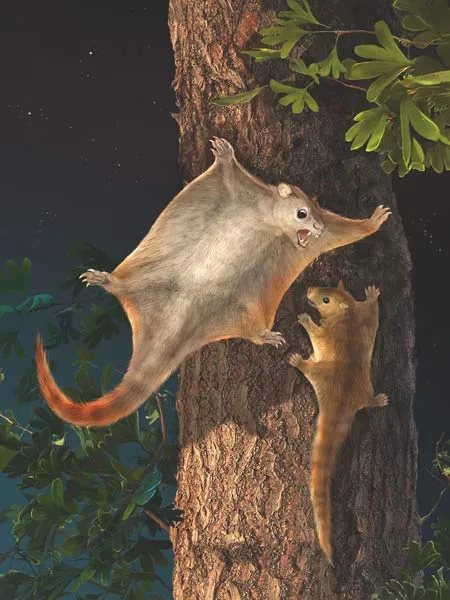
A new order of mammals has been named based on a recently discovered fossil of a squirrel-sized Mesozoic-era animal [image] that lived at least 130 million years ago and was capable of gliding flight.
The ancient mammal, Volaticotherium antiquus, represents a previously unknown group that bore features adapted for arboreal life. This fossil, found in Inner Mongolia, China, puts the first record of gliding flight for mammals at least 70 million years earlier than had been known, the researchers write in the Dec. 14 issue of the journal Nature.
Latest Videos From
Swipe to scroll horizontally
Pecking Order
In biological classification every organism fits into a hierarchy:
Kingdom
Phylum
Class
Order
Family
Genus
Species
Previously, the earliest record of flight in mammals was found in fossils of bats dating back to 51 million years ago, said lead study author, Jin Meng from the American Museum of Natural History in New York. "Of course the bats at that time already had the ability of flapping flight not just gliding, so proto-bats could have been gliders but we don't have any fossil records of that."
Telling teeth
The specimen was found in a book-sized slab. Bones, teeth and impressions of the soft tissue were preserved. This allowed the researchers to classify this prehistoric animal.
"If you're looking for a mammal, the first thing you will look at is the teeth," Meng told LiveScience.
Sign up for the Live Science daily newsletter now
Get the world’s most fascinating discoveries delivered straight to your inbox.
Mammalian teeth have developed into four sets: incisors, canines, premolars and molars. Incisors are in the front and considered cutting teeth. Canines are the sharp stabbing teeth. Premolars and molars stand behind the canines and are used for grinding food. This specimen has all those features.
"So we can tell that this is a mammal from the dental formula," Meng said. "Also, we can tell from the teeth morphology, because it's very sharp and very hook-like, that this is an insectivore mammal."
Unlike herbivores such as the flying squirrel that eats fruits, leaves, and nuts, this ancient gliding beast fed on insects.
Extinct lineage
The fossil also preserved a large piece of the animal's skin membrane [image].
"We know this [was skin] because it was covered with dense hair," Meng said. "The fur or body hair is another mammalia characteristic. So by finding that, we know that this animal has this large body skin membrane that is used for gliding. And only gliding mammals have that kind of morphology."
The V. antiquus, weighing in at less than a pound, is comparable in size and shape to flying squirrels. However, the mammal is not considered a direct ancestor of these or other flying mammals.
Instead, V. antiquus provides evidence for the independent origin of flight in this now-extinct lineage of mammals, the researchers conclude.
"It's unusual to find such a unique creature," Meng said. "Establishing a new order probably only happens once, if that, in the lifetime of a lucky paleomammalogist."
Sara Goudarzi is a Brooklyn writer and poet and covers all that piques her curiosity, from cosmology to climate change to the intersection of art and science. Sara holds an M.A. from New York University, Arthur L. Carter Journalism Institute, and an M.S. from Rutgers University. She teaches writing at NYU and is at work on a first novel in which literature is garnished with science.

 Live Science Plus