 Live Science Plus





You are now subscribed
Your newsletter sign-up was successful
Want to add more newsletters?

Delivered Daily
Daily Newsletter
Sign up for the latest discoveries, groundbreaking research and fascinating breakthroughs that impact you and the wider world direct to your inbox.
Once a week
Life's Little Mysteries
Feed your curiosity with an exclusive mystery every week, solved with science and delivered direct to your inbox before it's seen anywhere else.
Once a week
How It Works
Sign up to our free science & technology newsletter for your weekly fix of fascinating articles, quick quizzes, amazing images, and more

Delivered daily
Space.com Newsletter
Breaking space news, the latest updates on rocket launches, skywatching events and more!

Once a month
Watch This Space
Sign up to our monthly entertainment newsletter to keep up with all our coverage of the latest sci-fi and space movies, tv shows, games and books.

Once a week
Night Sky This Week
Discover this week's must-see night sky events, moon phases, and stunning astrophotos. Sign up for our skywatching newsletter and explore the universe with us!
Join the club
Get full access to premium articles, exclusive features and a growing list of member rewards.
DNA molecules can display what almost seems like telepathy, research now reveals.
Double helixes of DNA can recognize matching molecules from a distance and then gather together, all seemingly without help from any other molecules, scientists find. Previously, under the classic understanding of DNA, scientists had no reason to suspect that double helixes of the molecule could sort themselves by type, let alone seek each other out.
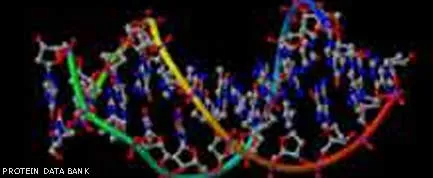
The spiraling structure of DNA includes strings of molecules called bases. Each of its four bases, commonly known by the letters A, T, C and G, is chemically attracted to a specific partner — A likes binding to T, and C to G. The scheme binds paired strands of DNA into the double helix the molecule is famous for.
Scientists investigated double-stranded DNA tagged with fluorescent compounds. These molecules were placed in saltwater that contained no proteins or other material that could interfere with the experiment or help the DNA molecules communicate.
Curiously, DNA with identical sequences of bases were roughly twice as likely to gather together as DNA molecules with different sequences.
The known interactions that draw the bases together are not the factor bringing these double helixes close. Double helixes of DNA keep their bases on their insides. On their outsides, they have highly electrically charged chains of sugars and phosphates, which obscure the forces that pull bases together.
Although it looks as if spooky action or telepathic recognition is going on, DNA operates under the laws of physics, not the supernatural.
To understand what researchers conjecture is really happening, think of double helixes of DNA as corkscrews. The bases that make up a strand of DNA each cause the corkscrew to bend one way or the other. Double-stranded DNA with identical sequences each result in corkscrews "whose ridges and grooves match up," said researcher Sergey Leikin, a physical biochemist at the National Institute of Child Health and Human Development in Bethesda, Md.
The electrically charged chains of sugars and phosphates of double helixes of DNA cause the molecules to repel each other. However, identical DNA double helixes have matching curves, meaning they repel each other the least, Leikin explained.
The scientists conjecture such "telepathy" might help DNA molecules line up properly before they get shuffled around. This could help avoid errors in how DNA combines, errors that underpin cancer, aging and other health problems. Also, the proper shuffling of DNA is essential to sexual reproduction, as it helps ensure genetic diversity among offspring, Leikin added.
Leikin and his colleagues will detail their findings in the Jan. 31 issue of the Journal of Physical Chemistry B.

