













Photos: What Big Eyes! Spider's Huge Peepers Help Snag Prey

Spiders

Net-casting spiders have the largest eyes of any spider on Earth. But only two of their eyes are enormous; the other six are small and have diminished vision. To get a better idea of how these spiders use their gigantic eyes, researchers painted temporary coverings over the spiders' eyes, and watched the arachnids catch prey.
As it turns out, these large eyes are crucial in helping the spider to hunt at night (when there is less light) and to catch prey that walks by the arachnid's web.[Read the Full Story on These Big-Eyed Spiders]
Web-ready

Net-casting spiders build A-shaped webs to catch prey.
Subtropical living

These spiders live in subtropical areas, such as Costa Rica, southern Georgia and parts of Florida.
Nighttime hunters

The spider species Deinopis spinosa tends to hunt at night.
Dinnertime

Net-casting spiders eat other arthropods that are smaller than them, including ants, moths, mosquitoes and other spiders.
Palm-tree trap

In Florida, Deinopis spinosa spiders tend to build webs on palm trees. "During the day, they [the spiders] look like sticks, and at night they come out and do all of this cool behavior," said study lead researcher Jay Stafstrom, a doctoral student of biological sciences at the University of Nebraska-Lincoln.
Get the world’s most fascinating discoveries delivered straight to your inbox.
Lost in its eyes
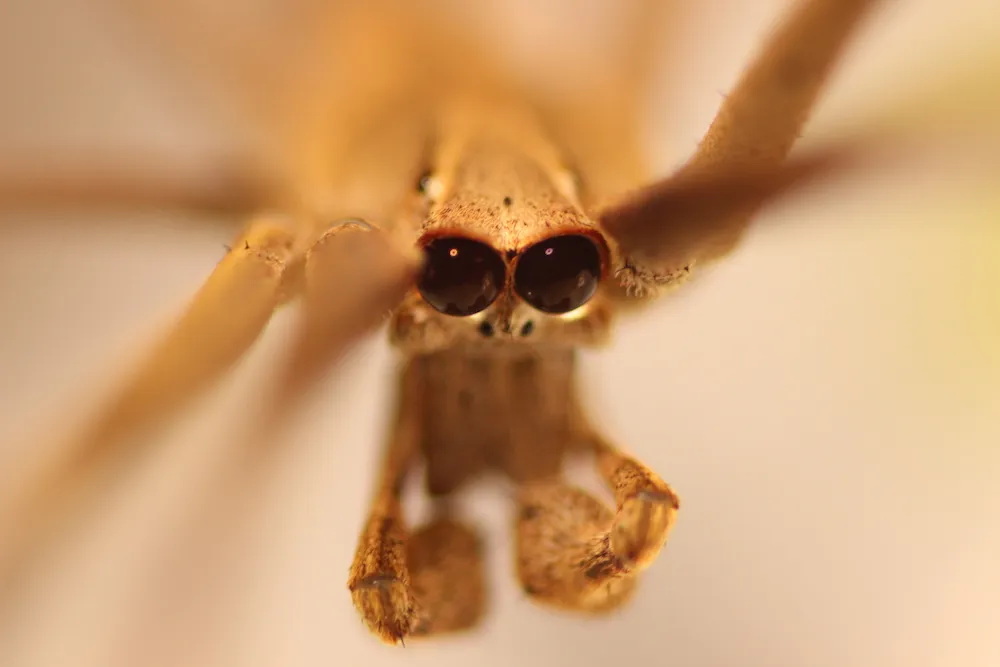
Net-casting spiders have the largest eyes of any spider.
Want a hug?
Net-casting spiders with dental silicone painted over their eyes have more trouble catching prey than able-eyed spiders do, the study found.
An eyeful

The net-casting spider's large eyes also help it hunt at night, during low-vision situations. This likely helps it avoid predators that hunt during the day, such as birds, the researchers said.
Follow Laura Geggel on Twitter @LauraGeggel. Follow Live Science @livescience, Facebook & Google+.

Laura is the managing editor at Live Science. She also runs the archaeology section and the Life's Little Mysteries series. Her work has appeared in The New York Times, Scholastic, Popular Science and Spectrum, a site on autism research. She has won multiple awards from the Society of Professional Journalists and the Washington Newspaper Publishers Association for her reporting at a weekly newspaper near Seattle. Laura holds a bachelor's degree in English literature and psychology from Washington University in St. Louis and a master's degree in science writing from NYU.