 Live Science Plus





A Garden Grows in Space: First Zinnias Bloom, to Astronaut's Delight
You are now subscribed
Your newsletter sign-up was successful
Want to add more newsletters?

Delivered Daily
Daily Newsletter
Sign up for the latest discoveries, groundbreaking research and fascinating breakthroughs that impact you and the wider world direct to your inbox.

Once a week
Life's Little Mysteries
Feed your curiosity with an exclusive mystery every week, solved with science and delivered direct to your inbox before it's seen anywhere else.

Once a week
How It Works
Sign up to our free science & technology newsletter for your weekly fix of fascinating articles, quick quizzes, amazing images, and more
Delivered daily
Space.com Newsletter
Breaking space news, the latest updates on rocket launches, skywatching events and more!
Once a month
Watch This Space
Sign up to our monthly entertainment newsletter to keep up with all our coverage of the latest sci-fi and space movies, tv shows, games and books.

Once a week
Night Sky This Week
Discover this week's must-see night sky events, moon phases, and stunning astrophotos. Sign up for our skywatching newsletter and explore the universe with us!
Join the club
Get full access to premium articles, exclusive features and a growing list of member rewards.
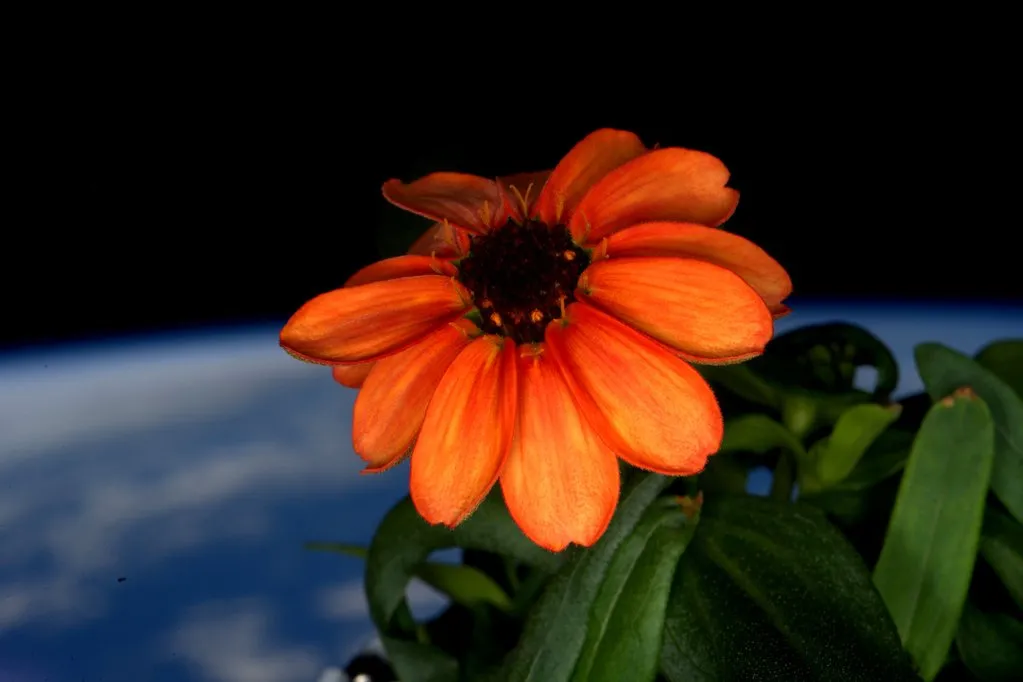
Zinnias have opened their pretty petals for the first time on the International Space Station, and NASA astronaut Scott Kelly couldn't be prouder.
The zinnias, grown as part of the Veggie program, have had a rough path: They battled excessive water, overdrying and even enterprising mold before beginning to recover in early January.
To better balance conditions for the zinnias, NASA named Kelly an autonomous gardener (or "commander" of Veggie) on Christmas Eve, so he could independently decide when the plants needed to be watered or tended to instead of waiting for directives from Earth. It looks like that hard work has paid off, with new photos of the zinnia's first vivid orangey-yellow bloom.
Earlier this year, the space station crew grew romaine lettuce (and snacked on it, while their cosmonaut colleagues were on a spacewalk), but the zinnias are a stride forward because they are more challenging to grow, with more exacting environmental requirements.
"The zinnia plant is very different from lettuce," Trent Smith, Veggie project manager, said in a statement. "It is more sensitive to environmental parameters and light characteristics. It has a longer growth duration between 60 and 80 days. Thus, it is a more difficult plant to grow, and allowing it to flower, along with the longer growth duration, makes it a good precursor to a tomato plant."
Many plants have been grown in space — including sunflowers, in 2012 — but the Veggie program aims to learn about how to grow a complicated plant through its entire life cycle and overcome the hurdles on the way.
From …
… to …
… to …
Once they conquer zinnias, astronauts might be able to grow other flowering plants, like tomatoes, that could tide astronauts over on long journeys, NASA officials said in the statement.
But for now, the astronauts can come together to marvel at those zinnias growing far from home. Kelly is joined by NASA astronaut Tim Kopra and European Space Agency astronaut Tim Peake, along with cosmonauts Mikhail Kornienko, Sergey Volkov and Yuri Malenchenko. Along with Kornienko, Kelly will end his yearlong stay on the space station in March.
Email Sarah Lewin at slewin@space.com or follow her @SarahExplains. Follow us @Spacedotcom, Facebook and Google+. Original article on Space.com.
