













Laser Weapon Melts Test Drone in Midair
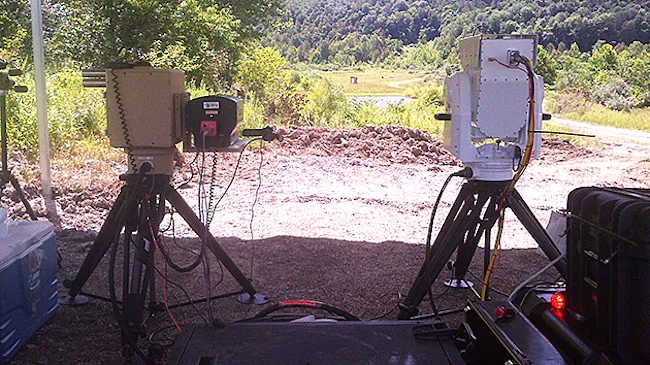
A new laser weapon that can burn up targets in just a few seconds recently melted and destroyed a test drone flying over California.
Known as the Compact Laser Weapons System, the futuristic, drone-shooting weapon is a smaller, more versatile version of the High Energy Laser Mobile Demonstrator (HEL MD), a system developed by Boeing to be mounted on top of U.S. Army vehicles.
Both weapons forgo conventional bullets for "directed energy"— a focused beam of energy that heats up and damages a target. [7 Technologies That Transformed Warfare]
"Think of it like a welding torch being put on a target, but from many hundreds of meters away," Isaac Neal, a Boeing engineer, said in a video about the new weapons system that was posted on the defense contractor's website.
In a recent test, the laser, which is compact enough to carry around in a suitcase, was able to locate, aim and fire at a small drone flying above a testing facility in Point Mugu, California. The laser gun acts quickly (it took just 15 seconds for it to shoot the test drone out of the sky) and discreetly, according to Neal. Speedy reaction times can be important in battles when every second counts.
"If you were on the receiving end of laser energy, you would have no idea where it was coming from or what was even happening," Neal said in the video.
The Compact Laser Weapons System features four main parts that help it turn plain old energy into a deadly force: It has a battery, a chiller that keeps the system from getting too hot, a 2-kilowatt laser and a "beam director" that points the laser light at the intended target.
Get the world’s most fascinating discoveries delivered straight to your inbox.
Engineers designed the system to be lighter and more compact than its big cousin, the HEL MD, by redesigning the beam director. The first prototype of the Compact Laser Weapons System is 40 percent lighter than the vehicle-mounted HEL MD system, said Neal, who noted that this lower weight makes the portable laser gun easier to move around than the HEL MD.and also allows the motors that control the compact system's beam director to function quickly.
Both the HEL MD and the smaller laser weapon can be operated by one person, but the main advantage of the Compact Laser Weapons System is that it can be used just about anywhere. While the bigger system features a more powerful, 10-kW laser, it's fixed to the top of a vehicle, so it can only go where the vehicle goes.
In the recent test in California, the smaller laser shot down a drone, but Boeing's goal is to develop a compact laser that can also shoot down incoming explosives, such as mortars, missiles and smaller artillery — something the HEL MD has already proved it can do in tests.
The big draw for both laser systems is that they're cost-effective weapons. The only cost associated with operating them is the cost of electricity to power the lasers, according to Boeing, which did not state exactly how much the U.S. military would save by switching to laser guns.
Last year in Washington, D.C., Rear Adm. Matthew Klunder, chief of naval research, told reporters that firing the Navy's 30-kilowatt laser weapons system, or LaWS, costs less than a dollar per shot.
Follow Elizabeth Palermo @techEpalermo. Follow Live Science @livescience, Facebook & Google+. Original article on Live Science.