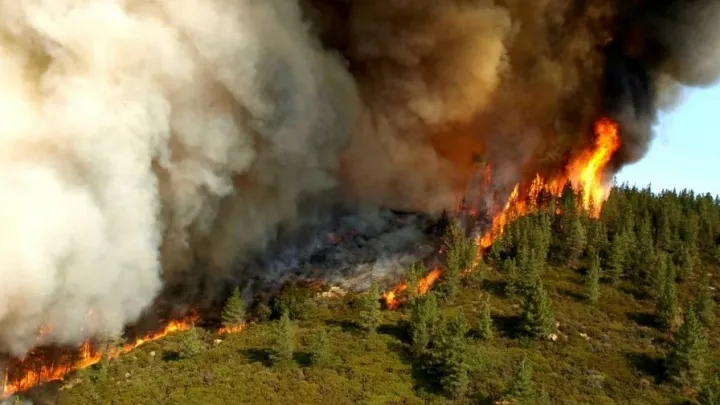
California is now well into its fourth consecutive year of drought. This is not without consequences. Tensions in the state have mounted as urban and agricultural water users become increasingly stressed by water shortages — but we can't blame the almond farmers. There are many factors at play here, notably a complex water cycle and conveyance network, as well as a somewhat archaic legal landscape. One thing that all Californians can agree upon is that we need to find solutions, because the drought is affecting livelihoods and the environment in a serious way.
Climate change has likely played a pivotal role in exacerbating the California drought. A team of Stanford researchers have shown that one driver for this is a persistent region of high atmospheric pressure off the state's coast, keeping storms and rainfall away from land. These conditions are much more likely to occur with the high greenhouse gas concentrations that we are experiencing today. In exploring climate model projections, it appears that the situation will get worse.
By 2080, climate models agree that California stands to experience a decrease in average rainfall accompanied with an increase in average temperatures.
Using multi-model averages from 16 recent Intergovernmental Panel on Climate Change climate projections — and assuming the "A2" future scenario that, albeit pessimistic, reflects conceivable rates of global greenhouse gas emissions — I analyzed impacts across three major land types: urban areas, croplands and rangelands. [It's Raining Spiders! Weirdest Effects of California Drought ]
From the data, three alarming conclusions emerge:
Sign up for the Live Science daily newsletter now
Get the world’s most fascinating discoveries delivered straight to your inbox.
Temperatures in California are expected to rise on average by 7 degrees Fahrenheit (4 degrees Celsius) by 2080.
Rainfall at that time will plummet between 2 to 16 percent below current levels.
All of these lands will be exposed to varying degrees of impacts.
Combined, those changes will have a devastating effect on cities, crops and ranching operations across the state.
Croplands: Yields suffer as temperatures rise and rainfall dips
Most critically affected are lands essential to our food security, yet which also require the most water: croplands.
Most of California's croplands are located in the farm-rich Central Valley, a geographic area that the models project will likely be exposed to increasingly severe climate impacts over the next six decades. [Building a Drought-Proof Farm (Op-Ed )]
Temperatures will range between 6.5 to 7.5 F (3.6 to 3.8 degrees Celsius) higher, and rainfall may decline between 6 to 14 percent in major farmland areas, harming food production and environmental integrity in a region that produces nearly half of all vegetables, fruits and nuts consumed in the United States.
Rangelands: A variety of outcomes in a warmer climate
Cattle farming and dairy production are California's largest agricultural exports, according to the U.S. Department of Agriculture. Ranches and healthy pastures for grazing are essential to those operations.
My analysis suggests rangelands will experience a wider range of impacts than croplands — this stands to reason, as these grasslands are more widely distributed across the state, covering a large area and a diverse array of biomes.
Cities: Water becomes increasingly scarce
Finally, we turn to California's urban areas. As significant water users, settlements throughout the state could be affected even more severely than croplands, with larger cities such as Los Angeles and San Diego located in regions where average annual rainfall may drop by as much as 14 percent by 2080.
If you're a topical expert — researcher, business leader, author or innovator — and would like to contribute an op-ed piece, email us here.
What does all this mean?
If there's one takeaway from the analysis, it's that many of these regions will have to endure more droughts and hardship in the longer term if we don't get our act together.
More than any state, California is leading the way when it comes to tackling climate change — but a global, concerted effort is needed to create a better future. The U.S. Environmental Protection Agency recently finalized the Clean Power Plan, which means the United States is taking steps in the right direction.
However, we need to find lasting solutions to the climate problem, such as:
Placing limits on power plant pollution.
Putting an end to deforestation.
Expanding carbon markets.
Phasing out fossil fuel subsidies.
Stopping methane leaks.
These are just some of the things we need, to keep things from getting worse. Just ask thirsty California.
Follow all of the Expert Voices issues and debates — and become part of the discussion — on Facebook, Twitter and Google+. The views expressed are those of the author and do not necessarily reflect the views of the publisher. This version of the article was originally published on Live Science.