













African Golden Cat Attacks Monkeys in Rare Camera Trap Footage

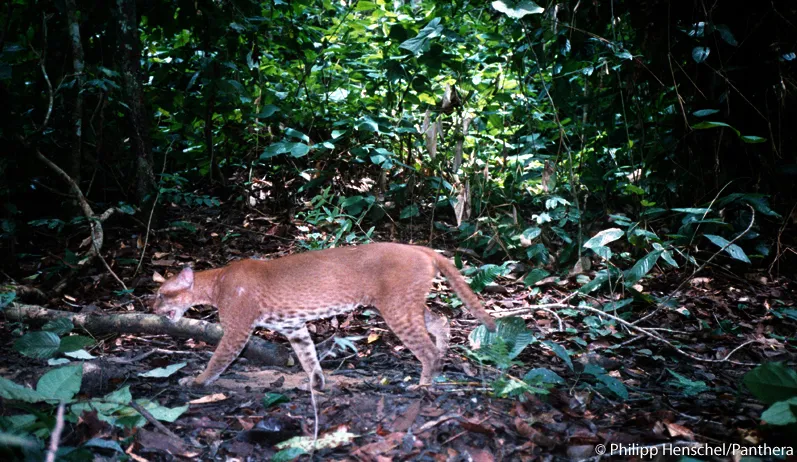
African golden cats are hardly ever photographed in the wild. In their rare, camera-trap cameos, the cats are usually seen licking their spotted fur or innocuously inspecting the unfamiliar lens.
But recently, scientists captured a much more dynamic scene: a golden cat crashing a party of red colobus monkeys in Uganda.
The video, released yesterday (Jan. 27), may be the first footage of a golden cat hunting in the daylight, according to Panthera, the conservation group that released the video from inside Kibale National Park. [Beastly Feasts: Amazing Photos of Animals and Their Prey]
"We know a lot more about golden cats than we did a few years ago, and yet we still know almost nothing about their behavior," David Mills, a graduate student at the University of KwaZulu-Natal (UKZN) in South Africa, said in a statement. "Primatologists in Kibale have observed monkeys emitting alarm calls at golden cats on several occasions, and considering this latest evidence, it's not hard to see why."
The video was recorded from a camera trap set up by researchers from the Max Planck Institute for Evolutionary Anthropology in Germany. In the beginning of the clip, a group of adult red colobus monkeys feeds on the dead wood of a tree stump. The attack happens suddenly. A cat leaps from the bushes and briefly wrestles with the monkey slowest to flee. A slow-motion version of the video makes it clear that the cat was unsuccessful; it quickly retreats when it fails to get a fatal hold on its prey.
African golden cats are comparable in size to bobcats. They can weigh 11 to 35 lbs. (5 to 16 kilograms). Red colobus monkeys, which weigh 15 to 27 lbs. (7 to 12 kg), can put up a good fight against the cats — and they aren't always on the defensive. Another video released by Panthera shows a group of colobus monkeys harassing a golden cat that's trying to sleep in a tree in Uganda's Kalinzu Forest Reserve.
African golden cats, which are listed as near-threated by the International Union for Conservation of Nature (IUCN), are found in the forests of central and west Africa. They were photographed for the first time in the wild in 2002, and once in a while, new footage of the animals emerges. Two years ago, for example, scientists with the Wildlife Conservation Society (WCS) captured a video of an African golden cat in Kibale. The researchers said they lured the creature to the camera trap with Calvin Klein's Obsession for Men. The cologne contains civetone, which comes from the scent glands of civets, small mammals that are native to Africa and parts of Asia.
Get the world’s most fascinating discoveries delivered straight to your inbox.
Follow Megan Gannon on Twitter. Follow us @livescience, Facebook & Google+. Original article on Live Science.
