













Off with Their Heads! Tiny Flies Decapitate Ants for Dinner

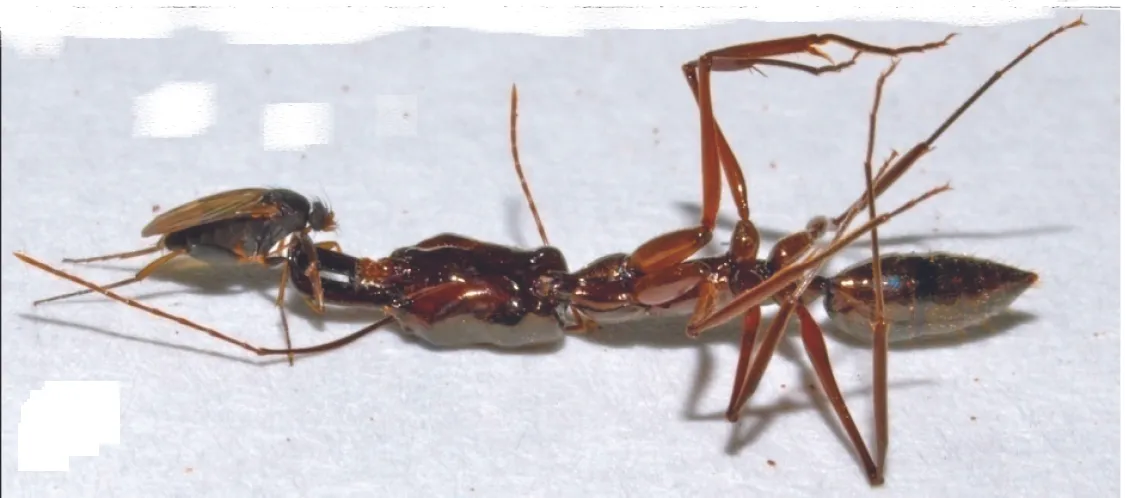
There are tiny tropical flies that turn fire ants into zombies with larvae that eat the ant's brain. But wait: This fly story gets even better.
Researchers have discovered a related group of female flies that bite off ant heads and then haul them away for dinner.
"Anything you put on the tropical forest floor is immediately swarmed by some sort of ant, so it's a nice little defense to sequester a chunk of ant meat away from the competition," said Brian Brown, curator of entomology at the Los Angeles Natural History Museum. [See video of headhunting flies decapitating ants]
The Dohrniphora flies quickly guillotine their prey with a long, sawlike proboscis, always targeting injured ants to avoid becoming dinner themselves. The flies are just fractions of an inch (1 to 3 millimeters) long — as tall as a nickel — and smaller than the ant's giant head. They only dine on trap-jaw ants (Odontomachus).
"Ants are nasty, belligerent creatures that often fight each other to the death and leave the injured to die," Brown said. "These flies have found a small niche to exploit that's been highly productive."
Pheromones wafting from the injured ants cue the flies to come get their meal, the researchers think. Only adult females go after ant heads, but both males and females are attracted to the feast. The flies usually arrived in flagrante, as fornicating pairs, the researchers reported. After the pairs landed, the males immediately fled, and the females went hunting.
Most of the females examined by the researchers were egg-free, so the ant heads could serve as a nutritious snack to fuel egg development, the researchers said.
Get the world’s most fascinating discoveries delivered straight to your inbox.
"It doesn't seem likely that females and males are randomly flying around, copulating," Brown said. "It's possible they need to have some feeding to develop a batch of eggs." Some mosquito species need a blood meal before they can develop and lay eggs, he noted.
Both the brain-sucking parasitic flies and the ant beheaders belong to the phorid family. There are thousands of phorid species, and scientists have only begun to find some of the fascinating and highly specialized niches they fill. For instance, there is a phorid fly surviving on fungus that only grows inside of stinkbugs, Brown said. "The biodiversity is just amazing," he said.
There are seven species in the Dohrniphora group, found from Costa Rica and southern Mexico to northern Argentina. The researchers saw the head-eating behavior in three species, though it could be common to all seven, according to the findings, published Jan. 2 in Biodiversity Data Journal.
Brown was with a group of museum entomologists stalking parasitic phorid flies in Minas Gerais, Brazil, when one of the researchers, study co-author Giar-Ann Kung, spotted a tiny fly swoop in and tug the head off of an injured trap-jaw ant.
"Encountering a life history like this is so lucky because you have to be in the right place at the right time," Brown said. "It was totally unexpected."
Follow Becky Oskin @beckyoskin. Follow Live Science @livescience, Facebook & Google+. Originally published on Live Science.
