













Strange Spikes Over Siberia Puzzle Astronauts

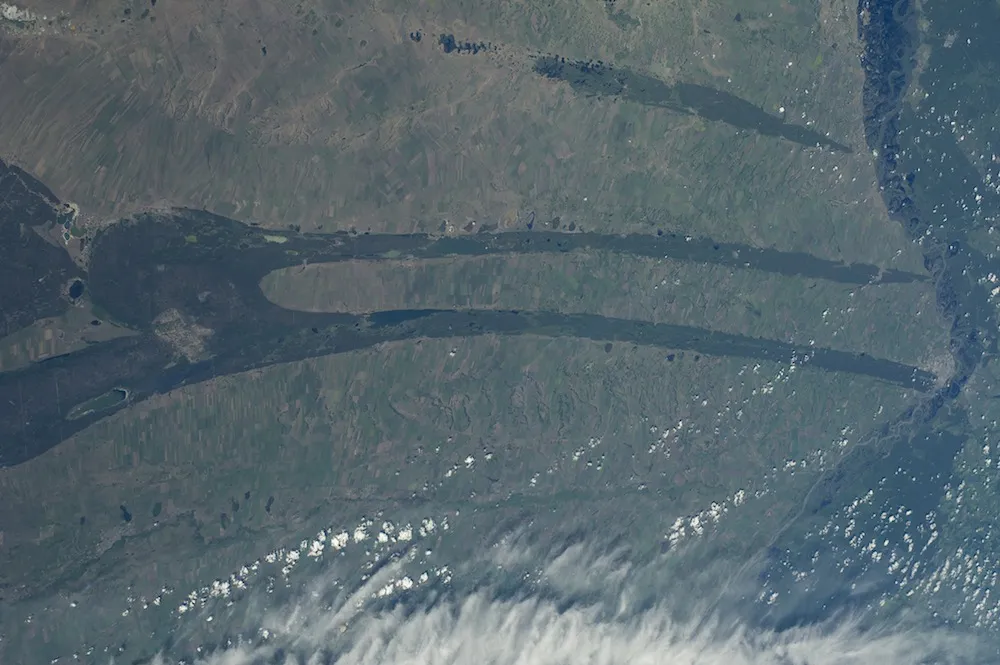
Houston, we have a question: What are these weird spiky shapes we're seeing as we fly over Siberia?
That's what astronauts were asking this June, when the sight of strange, dark-green features running along Siberia's Kulunda Steppe left them stumped, according to NASA's Earth Observatory. The curving features streak across the plain near the Ob River, and can be seen from the International Space Station (ISS) when it flies over the Northern Hemisphere's 52nd parallel, the highest latitude of its orbit.
Fortunately for the ISS astronauts' burning curiosity, researchers at NASA Johnson Space Center in Houston had answers. The spikes are a side effect of the geology of the region: Folded surface rocks (shaped by tectonic forces) dip lower than the surrounding land, creating long, linear valleys filled with pine forests. From space, the pines appear as a darker shade of green than the surrounding agricultural fields, according to the Earth Observatory.
The spikes also appear in a winter scene snapped by an ISS astronaut more than a decade ago, in 2003. In that image, snow covers the fields surrounding the folds, doubly highlighting the pine forests within. [Photos: The 10 Strangest Places on Earth]
The Siberian spikes aren't the only odd feature of the Kulunda Steppe. The landscape is dotted with saltwater lakes, including Gorkoye Lake, which can be seen within the dark-green forest on the left side of this image. According to the region's tourism department, people visit the lake's waters, as well as the rich mud at the lake's bottom, for healing purposes.
Despite getting little water from rain, the Kulunda Steppe is an agricultural center of Russia and a major source of wheat. In 2013, the German Federal Ministry of Education and Research gave German researchers 3.2 million euros (about $4.2 million) to fund a sustainable farming project in the region. According to a statement from Martin Luther University Halle-Wittenberg, many of the farmers of the Kulunda Steppe are ethnic Germans.
Poor agricultural practices in the mid-20th century led to soil erosion on the Steppe. To save Russia's breadbasket, researchers are now working on sustainable farming strategies, including rotating crops and ditching the plow.
Get the world’s most fascinating discoveries delivered straight to your inbox.
Editor's Note: If you have an amazing nature or general science photo you'd like to share for a possible story or image gallery, please contact managing editor Jeanna Bryner at LSphotos@livescience.com.
Follow Stephanie Pappas on Twitter and Google+. Follow us @livescience, Facebook & Google+. Original article on Live Science.

Stephanie Pappas is a contributing writer for Live Science, covering topics ranging from geoscience to archaeology to the human brain and behavior. She was previously a senior writer for Live Science but is now a freelancer based in Denver, Colorado, and regularly contributes to Scientific American and The Monitor, the monthly magazine of the American Psychological Association. Stephanie received a bachelor's degree in psychology from the University of South Carolina and a graduate certificate in science communication from the University of California, Santa Cruz.