 Live Science Plus





You are now subscribed
Your newsletter sign-up was successful
Want to add more newsletters?

Delivered Daily
Daily Newsletter
Sign up for the latest discoveries, groundbreaking research and fascinating breakthroughs that impact you and the wider world direct to your inbox.

Once a week
Life's Little Mysteries
Feed your curiosity with an exclusive mystery every week, solved with science and delivered direct to your inbox before it's seen anywhere else.
Once a week
How It Works
Sign up to our free science & technology newsletter for your weekly fix of fascinating articles, quick quizzes, amazing images, and more

Delivered daily
Space.com Newsletter
Breaking space news, the latest updates on rocket launches, skywatching events and more!
Once a month
Watch This Space
Sign up to our monthly entertainment newsletter to keep up with all our coverage of the latest sci-fi and space movies, tv shows, games and books.

Once a week
Night Sky This Week
Discover this week's must-see night sky events, moon phases, and stunning astrophotos. Sign up for our skywatching newsletter and explore the universe with us!
Join the club
Get full access to premium articles, exclusive features and a growing list of member rewards.
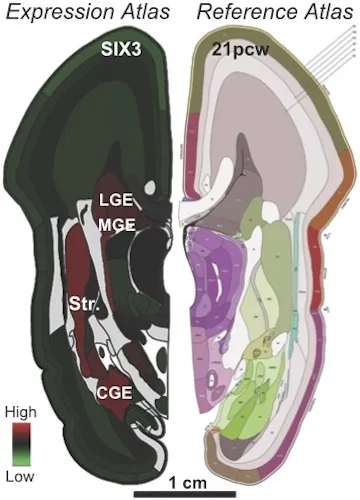
A new map of the human brain during its development in the womb provides a detailed blueprint of where different genes are active at this critical stage of in a fetus' life.
This brain atlas yields clues about what makes humans distinct from other animals, and when disorders like autism first take root, researchers say.
"This is another installment in our suite of brain atlases to try to map how all genes are used across the brain and across development," said study leader Ed Lein, a neuroscientist at the Allen Institute for Brain Science in Seattle. [Image Gallery: Mapping the Brain]
The institute has previously developed maps of the developing and adult mouse brain, the developing monkey brain, and the adult human brain. The new map is the first to look at the developing human brain — specifically, the developing neocortex, the seat of higher cognitive functions, Lein told Live Science. The map is precise enough that scientists can use it to study different types of cells at various stages of development, he added.
Snapshot of a developing brain
Researchers created the map using healthy prenatal brains from a brain bank — a collection of donated human brains. The team used brain tissue with no known abnormalities or viruses such as HIV. Researchers took snapshots of brains at two different stages of prenatal development.
To measure gene activity, the researchers used a powerful tool known as a DNA microarray, which yields a quantitative measurement of the activity of every gene in the human genome simultaneously — about 20,000 genes in total.
The team compared these gene activity results with data from other species, in particular, the mouse brain. Mice are widely used in biomedical research as a model for humans, and these maps could give scientists insight into how mice brains are similar or different from human brains, Lein said.
Researchers found some genes that were turned on in the developing human brain but not in the mouse's brain, or vice versa. For example, the developing human brain contains genes that are more active in the frontal cortex than in the corresponding part of the mouse brain. The frontal cortex is linked to personality and decision-making.
Clues to brain disorders
The map of a healthy developing brain also provides clues to the origin of developmental disorders such as autism, the researchers said. Other studies have revealed certain genes that are active in autism. Lein's team saw these genes were turned on in newly generated excitatory neurons (which activate other neurons) in the prenatal cortex, suggesting autism may start in the womb, as opposed to later in life.
Taken together, these brain maps paint a picture of where and when different genes become active in the brain. The genes encode proteins that perform all the vital tasks inside neurons, giving rise to the complex cognition of the human brain.
The Allen Institute is one of the private organizations involved in the BRAIN Initiative (Brain Research through Advancing Innovative Neurotechnologies), launched by President Obama a year ago on April 2, 2013.
All of the Allen Institute brain atlases are freely available online.
The new findings are detailed today (April 2) in the journal Nature.
Follow Tanya Lewis on Twitter and Google+. Follow us @livescience, Facebook & Google+. Original article on Live Science.

