Inbreeding Helps African Fish, Scientists Say

Inbreeding often conjures visions of mutant offspring, but scientists now find it can have its upside in the wild.
Animals in the wild often avoid close kin as mates, as inbreeding causes harmful genes that might otherwise recede into the background to manifest in progeny more often. While animal breeders often practice inbreeding to cultivate desirable traits, they must then cull unfit offspring.
However, recent theoretical predictions suggest that, at times, the benefits of inbreeding might outweigh the costs. Now evolutionary biologist Timo Thünken at the University of Bonn in Germany and his colleagues has discovered real-life evidence in support of these predictions.
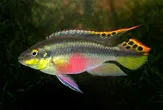
The scientists investigated the African cichlid Pelvicachromis taeniatus [image], a small monogamous fish that lives in the rivers and creeks of Cameroon and Nigeria. Males occupy caves, while females compete with each other for males.
"We initially wanted to investigate whether P. taeniatus avoid kin as mating partners, because it has been shown in other species that inbred offspring have disadvantages--for example, increased mortality," Thünken said.
"First, we conducted a female choice experiment," he recalled. This involved aquariums with breeding caves for males and hiding places for rejected females.
"Against our expectations, females did not avoid brothers, but even preferred them," Thünken told LiveScience. This proved true in 17 of 23 experiments.
Get the world’s most fascinating discoveries delivered straight to your inbox.
Both parents in the species care for their young to protect them against predators, the researchers noted. This requires high levels of cooperation.
Since kinship generally favors cooperation, Thünken and his colleagues theorized related parents did a better job of cooperating than non-kin. Their observations supported their ideas, finding that inbreeding pairs spent significantly more time accompanying their free-swimming young. They also discovered males of inbreeding pairs spent significantly more time guarding breeding caves and were half as likely to attack their mates.
The researchers curiously found that inbreeding did not appear to lead to higher rates of harmful gene expression. However, Thünken and his colleagues noted inbreeding might affect traits they have not yet studied, such as the fertility of offspring.
The scientists plan to look next at the level of inbreeding in natural populations of the fish, the fitness consequences of inbreeding and the mechanisms of kin recognition in the species.
Thünken and his colleagues reported their findings in the February 6 issue of the journal Current Biology.