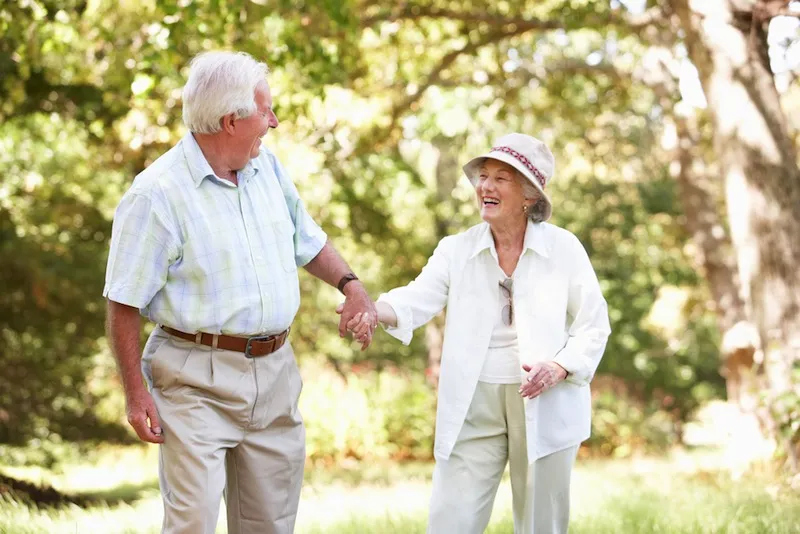
What is love? Maybe it means slowing down to walk at your beloved's pace.
New research finds that men adjust their walking speed to match their romantic partner's pace — a phenomenon not seen when guys walk with female friends. The findings have implications for understanding the evolution of human groups, given that early hunter-gatherers had to travel together, despite their diverse range of shapes and sizes.
Every individual has an optimal walking speed, researchers from Seattle Pacific University report today (Oct. 23) in the open-access journal PLOS ONE. Much of what determines that speed is height: the longer your legs are, the faster you're likely to walk — a fact that means men, on average, have a higher optimal speed than women do.
Latest Videos From
And speed matters, because this optimal point is the one at which a person moves the most efficiently, without wasting energy. When people walk together, someone has to pay the cost of adjusting his or her pace away from this optimum speed. [Men vs. Women: Our Top 6 Physical Differences Explained]
To find out who pays, the researchers recruited 11 heterosexual couples — a total of 22 men and women — and asked them to walk solo around a track. These initial walks set a baseline for each person's preferred pace, which averaged 3.4 mph (5.5 km/h) for men and 3.2 mph (5.1 km/h) for women.
Next, each person walked multiple laps around the track, alternating between walking alone and walking alongside another person. At various points, the person was joined by his or her romantic partner, by a same-sex friend and by an opposite-sex friend. For part of the walk with their romantic partner, the couples were instructed to hold hands.
The researchers timed the walks, and discovered that when a lovey-dovey couple walked together, the man slowed his pace to match his female partner's optimal speed. This occurred whether or not the two were holding hands.
When men and women in platonic friendships walked together, in contrast, both parties altered their speed. Men slowed slightly, and women sped up, to meet in the middle at about 3.3 mph (5.3 km/h).
When walking with someone of the same sex, men sped up so that both guys were chugging along at about 4 percent faster than their preferred pace. Women, on the other hand, slowed so that both walked about 3 percent slower than usual.
Many hunter-gatherer groups split into same-sex teams for long-distance travel, likely to prevent either men or women from having to pay an energy penalty to match each other's pace, the researchers wrote. In romantic relationships, however, men may have evolved to care for their partners, taking the energy hit so that the woman can save her effort for reproduction, they wrote.
Follow Stephanie Pappas on Twitter and Google+. Follow us @livescience, Facebook & Google+. Original article on LiveScience.