 Live Science Plus





You are now subscribed
Your newsletter sign-up was successful
Want to add more newsletters?

Delivered Daily
Daily Newsletter
Sign up for the latest discoveries, groundbreaking research and fascinating breakthroughs that impact you and the wider world direct to your inbox.

Once a week
Life's Little Mysteries
Feed your curiosity with an exclusive mystery every week, solved with science and delivered direct to your inbox before it's seen anywhere else.

Once a week
How It Works
Sign up to our free science & technology newsletter for your weekly fix of fascinating articles, quick quizzes, amazing images, and more

Delivered daily
Space.com Newsletter
Breaking space news, the latest updates on rocket launches, skywatching events and more!

Once a month
Watch This Space
Sign up to our monthly entertainment newsletter to keep up with all our coverage of the latest sci-fi and space movies, tv shows, games and books.

Once a week
Night Sky This Week
Discover this week's must-see night sky events, moon phases, and stunning astrophotos. Sign up for our skywatching newsletter and explore the universe with us!
Join the club
Get full access to premium articles, exclusive features and a growing list of member rewards.
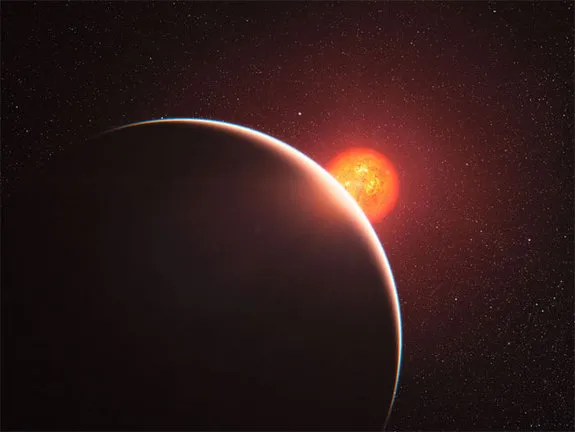
More than 50 new alien planets including one so-called super-Earth that could potentially support life have been discovered by an exoplanet-hunting telescope from the European Southern Observatory (ESO).
The newfound haul of alien planets includes 16 super-Earths, which are potentially rocky worlds that are more massive than our planet. One in particular has captured astronomers' attention because it orbits at the edge of its star's habitable zone, suggesting conditions could be ripe to support life .
A super-Earth is a planet with a mass between 1 and 10 times that of Earth. The super-Earth classification refers only to the mass of the planet, and does not imply anything about its surface conditions or habitability.
The first super-Earths, two exoplanets with masses 4 times that of Earth, were found orbiting a pulsar called PSR B1257+12 in 1992. The first super-Earth around a main sequence star one that is on order with our sun was discovered in 2005. With an estimated mass of 7.5 Earth masses, it orbits Gliese 876 and received the designation Gliese 876 d. Dozens more super-Earths have since been discovered, with masses as low as 1.9 Earth masses.
Astronomers have speculated that super-Earths might be more geologically active than our planet, and may experience more vigorous plate tectonics due to thinner plates that are under more stress. Those engaged in the search for alien life get excited about super-Earths because of the possibility that they could be rocky, and possibly habitable, unlike the gas giants.
- Top 3 Questions People Ask an Astrophysicist (and Answers )
- A Field Guide to Alien Planets
- Will We Really Find Alien Life In 20 Years?
Follow Life's Little Mysteries on Twitter @llmysteries, then join us on Facebook.

