













Gliese 581 Star's Habitable Zone Explained

Where there's water, there's the possibility of life. It just so happens that H2O acts as an ideal medium for chemical reactions between organic molecules, helping them link together to form amino acids the building blocks of proteins, and thus, cells.
For this reason, the "habitable zone" around a star, the zone in which there could be life, is the range of distance in which planets can maintain liquid water on their surfaces. Planets in a star's habitable zone are often called "Goldilocks planets": They aren't too hot, causing water to boil away, or too cold, causing it to freeze; instead, they're just right for liquid water and the life that could arise in it. [Read: What Are the Ingredients of Life? ]
Earth, for example, is nicely situated in our sun's habitable zone, which starts about midway between Earth and Venus and extends nearly to Mars.
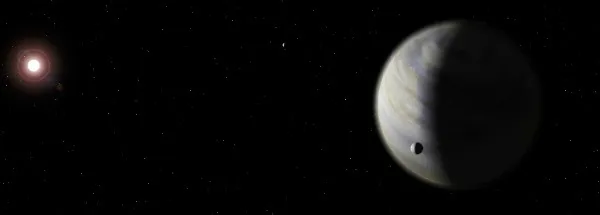
Gliese 581d, an exoplanet (planet outside our solar system) seven times the size of Earth, orbits a star called Gliese 581 that is 20 light-years away in the constellation Libra. When it was first discovered in 2007, Gliese 581d was thought to be just outside its star's habitable zone, but later, scientists discovered that Gliese 581d is just close in enough to potentially sustain liquid water. It "could even be covered by a large and deep ocean," one of its discoverers, astronomer Stephane Udry of the Geneva Observatory, said in 2009. "It is the first serious 'water world' candidate."
Now, further analysis suggests that not only is Gliese 581d in the habitable zone, it might even have a dense, stable atmosphere suitable for life. Robin Wordsworth and her colleagues at the Institute Pierre Simon Laplace constructed computer simulations to study the climate on Gliese 581d in a similar way as atmospheric scientists model climate patterns on Earth . Wordsworth's simulations "demonstrate [Gliese 581d] will have a stable atmosphere and surface liquid water for a wide range of plausible cases, making it the first confirmed super-Earth (exoplanet of 2-10 Earth masses) in the habitable zone," she writes in a new paper posted on the physics arXiv.
In the future, more detailed observations of the light spectrum coming from Gliese 581d will help researchers figure out whether the exoplanet's atmosphere is composed of the same greenhouse gases as Earth's, such as carbon dioxide, or whether it is made of lighter elements such as hydrogen and helium. The latter type of atmosphere wouldn't shield the planet from the star's high-frequency ultraviolet light, and so wouldn't be as conducive to life.
Follow Natalie Wolchover on Twitter @nattyover.
Get the world’s most fascinating discoveries delivered straight to your inbox.

Natalie Wolchover was a staff writer for Live Science from 2010 to 2012 and is currently a senior physics writer and editor for Quanta Magazine. She holds a bachelor's degree in physics from Tufts University and has studied physics at the University of California, Berkeley. Along with the staff of Quanta, Wolchover won the 2022 Pulitzer Prize for explanatory writing for her work on the building of the James Webb Space Telescope. Her work has also appeared in the The Best American Science and Nature Writing and The Best Writing on Mathematics, Nature, The New Yorker and Popular Science. She was the 2016 winner of the Evert Clark/Seth Payne Award, an annual prize for young science journalists, as well as the winner of the 2017 Science Communication Award for the American Institute of Physics.