 Live Science Plus





How Do Scientists Know the Universe is Expanding?
You are now subscribed
Your newsletter sign-up was successful
Want to add more newsletters?

Delivered Daily
Daily Newsletter
Sign up for the latest discoveries, groundbreaking research and fascinating breakthroughs that impact you and the wider world direct to your inbox.

Once a week
Life's Little Mysteries
Feed your curiosity with an exclusive mystery every week, solved with science and delivered direct to your inbox before it's seen anywhere else.

Once a week
How It Works
Sign up to our free science & technology newsletter for your weekly fix of fascinating articles, quick quizzes, amazing images, and more
Delivered daily
Space.com Newsletter
Breaking space news, the latest updates on rocket launches, skywatching events and more!
Once a month
Watch This Space
Sign up to our monthly entertainment newsletter to keep up with all our coverage of the latest sci-fi and space movies, tv shows, games and books.
Once a week
Night Sky This Week
Discover this week's must-see night sky events, moon phases, and stunning astrophotos. Sign up for our skywatching newsletter and explore the universe with us!
Join the club
Get full access to premium articles, exclusive features and a growing list of member rewards.
We thought we’d ask Geza Gyuk, Director of Astronomy at the Adler Planetarium and a research scientist at the University of Chicago. Here's what he said:
A few years after Albert Einstein had developed his famous (and by now very well tested!) theory of General Relativity (GR) in 1915 he applied it to the entire universe and found something remarkable. The theory predicts that the whole universe is either expanding or contracting . There really isn't any other alternative. To have the universe staying static is like a pencil balanced on its point... possible, but very, very unlikely and not liable to last for very long.
In 1929 the astronomer Edwin Hubble measured the velocities of a large selection of galaxies. He expected that about equal numbers would be moving toward and away from us. After all, the Earth isn't a particularly special place in the universe.
Instead, he discovered that almost all galaxies are moving away from us!
Since the time of Hubble we have observed millions of galaxies with better equipment and verified his results. With the exception of a small handful of galaxies close to us, every galaxy is moving away from us.
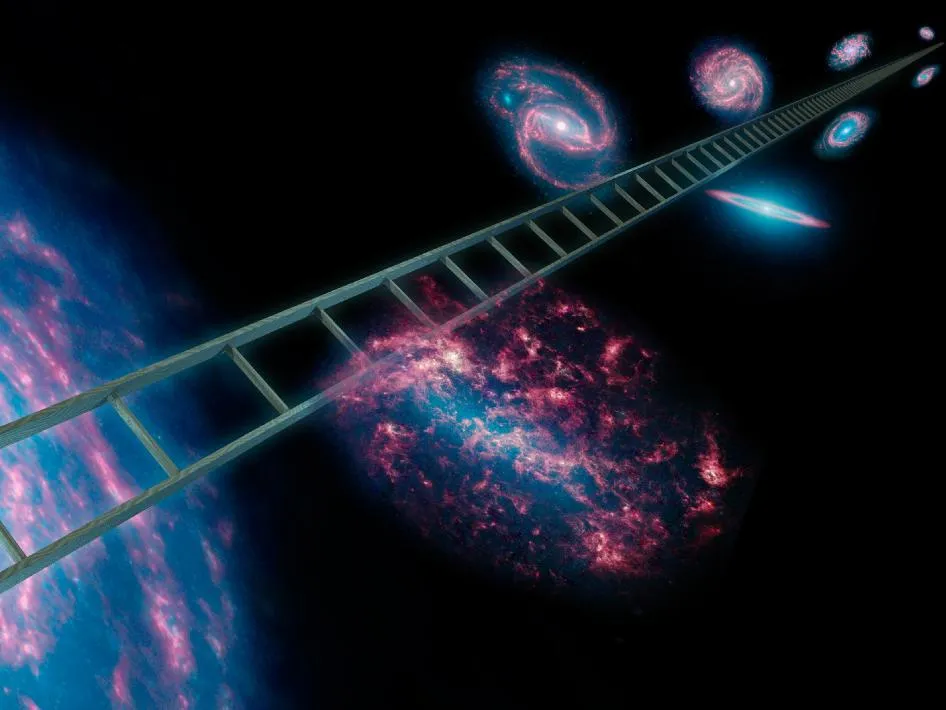
And in fact, the farther away a galaxy is the faster it is moving away from us. This fits in very well with Einstein's predictions. The galaxies seem to be receding from us because the entire universe is getting larger. The space in between the galaxies is stretching! And the farther away a galaxy is the more space there is to stretch so the faster the galaxy appears to move away from us.
Over the past half-century astronomers have observed many other facts about the universe that all point to the fact that the universe is expanding. While a very inventive person might be able to explain away one or at most two of these discoveries, the expansion of the universe is the only theory that can explain all of them at once. And with each passing year the evidence piles up higher!
Follow Life's Little Mysteries on Twitter @llmysteries. We're also on Facebook & Google+.
