














China's 'Celestial Mountains' Extend Across Central Asia

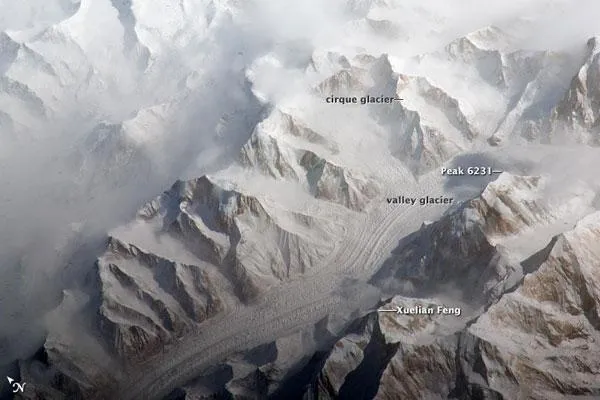
The Tien Shan "celestial mountains" in Chinese is one of the largest continuous mountain ranges in the world, extending approximately 1,550 miles (2,500 kilometers) roughly east-west across Central Asia.
This astronaut photograph, taken from aboard the International Space Station, provides a view of the central Tien Shan, about 40 miles (64 km) east of where the borders of China, Kyrgyzstan and Kazakhstan meet.
Like the Himalayas to the south, the uplift of the Tien Shan results from the ongoing collision between the Eurasian and Indian tectonic plates.
The rugged topography of the range is the result of subsequent erosion by water, wind and, in the highest parts of the range, active glaciers .
Two types of glaciers are visible in the image; cirque glaciers occupy amphitheater-like depressions on the upper slopes of the mountains, and feed ice downslope to aggregate into large valley glaciers such as the one at image center. Low clouds obscure an adjacent valley and glaciers to the north (upper left).
Two high peaks of the central Tien Shan are identifiable in the image. Xuelian Feng has a summit of 21,414 feet (6, 527 meters) above sea level. To the east, the aptly-named Peak 6231 has a summit 6,231 m (20,443 feet) above sea level.
Get the world’s most fascinating discoveries delivered straight to your inbox.
