 Live Science Plus


You are now subscribed
Your newsletter sign-up was successful
Want to add more newsletters?

Delivered Daily
Daily Newsletter
Sign up for the latest discoveries, groundbreaking research and fascinating breakthroughs that impact you and the wider world direct to your inbox.

Once a week
Life's Little Mysteries
Feed your curiosity with an exclusive mystery every week, solved with science and delivered direct to your inbox before it's seen anywhere else.

Once a week
How It Works
Sign up to our free science & technology newsletter for your weekly fix of fascinating articles, quick quizzes, amazing images, and more

Delivered daily
Space.com Newsletter
Breaking space news, the latest updates on rocket launches, skywatching events and more!

Once a month
Watch This Space
Sign up to our monthly entertainment newsletter to keep up with all our coverage of the latest sci-fi and space movies, tv shows, games and books.

Once a week
Night Sky This Week
Discover this week's must-see night sky events, moon phases, and stunning astrophotos. Sign up for our skywatching newsletter and explore the universe with us!
Join the club
Get full access to premium articles, exclusive features and a growing list of member rewards.
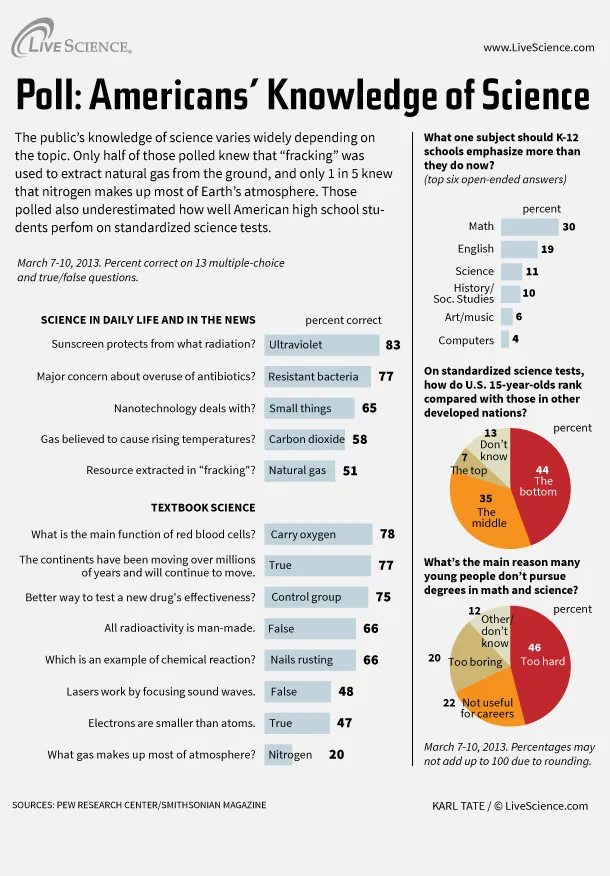
The public's knowledge of science varies widely depending on the topic. Only half of those polled knew that “fracking” was used to extract natural gas from the ground, and only 1 in 5 knew that nitrogen makes up most of Earth’s atmosphere. Those polled also underestimated how well American high school students perfom on standardized science tests.
In the category of science in daily life and in the news:
- 83 percent knew that sunscreen protects against ultraviolet radiation.
- 77 percent knew that the major concern about overuse of antibiotics is resistant bacteria.
- 65 percent knew that nanotechnology deals with small things.
- 58 percent knew that the gas believed to cause rising temperatures is carbon dioxide.
- 51 percent knew that the resource extracted in “fracking” is natural gas.
In the category of textbook science:
- 78 percent knew that the main function of red blood cells is to carry oxygen.
- 77 percent knew that the continents have been moving over millions of years and will continue to move.
- 75 percent knew that a better way to test a new drug’s effectiveness was by using a control group.
- 66 percent knew that all radioactivity is not man-made.
- 66 percent knew that an example of a chemical reaction is nails rusting.
- 48 percent knew that lasers do not work by focusing sound waves.
- 47 percent knew that electrons are smaller than atoms.
- 20 percent knew that nitrogen gas makes up most of Earth’s atmosphere.
The poll was conducted March 7-10, 2013, among a national sample of 1,006 adults 18 years of age or older living in the continental United States.

