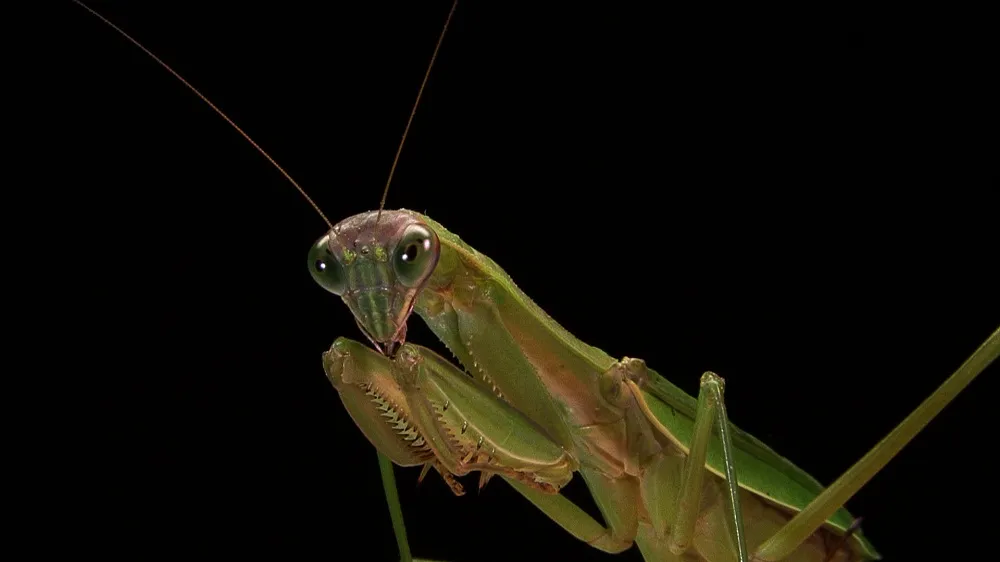
Some guys complain they've sacrificed their whole lives for their families. And in cases of sexual cannibalism — where the female eats the male after copulating — the guys literally give their all.
But how accurate is scientific research when describing acts of sexual cannibalism? A new study finds that scientists are prone to using loaded words that may color their interpretation of data and promote gender stereotypes, according to ScienceNow.
The study, published in the journal Animal Behaviour, found that in the 47 scientific papers on sexual cannibalism analyzed female cannibals were overwhelmingly described in negative terms such as "predatory," "voracious," "aggressive" and "rapacious." The behavior of the male partners, meanwhile, was typically described with words like "sacrifice" and "escape."
Latest Videos From
"The word 'sacrifice' implies a level of nobility, like they're doing something selfless," Emily Burdfield-Steel, a biologist at the University of St. Andrews in Scotland and co-author of the study, told ScienceNow. "But even for the males that are allowing themselves to be eaten, it's not selfless at all."
function reload_quiz_ads(){ reloadScripts(null, ['ad_imgBoard', 'ad_imgViewer']); } A 2011 study revealed that when a male orb-web spider Argiope bruennichi is eaten after sex, its offspring are healthier and live to bear larger eggs, suggesting there is some long-term biological advantage to being the meal in cases of sexual cannibalism.
"I have sympathy for efforts to remove biases in science, so was pleased to see this paper," Patricia Gowaty, an evolutionary biologist at the University of California, Los Angeles, told ScienceNow. "I wonder what in the world some of these words are doing in any scientific paper."
Even in cannibalistic species such as the praying mantis and the orb-web spider, not all sex acts result in the death of the male — among the praying mantis Tenodera sinensis, for example, sex results in death just 16 percent of the time, a 2012 study found.
The same study revealed that acts of cannibalism may be the result of simple hunger and lust: Females denied food for several days were more likely to munch their mates, while males denied sex were more willing to risk approaching a female even when she displayed signs of hunger.
Follow LiveScience on Twitter @livescience. We're also on Facebook& Google+.

 Live Science Plus