















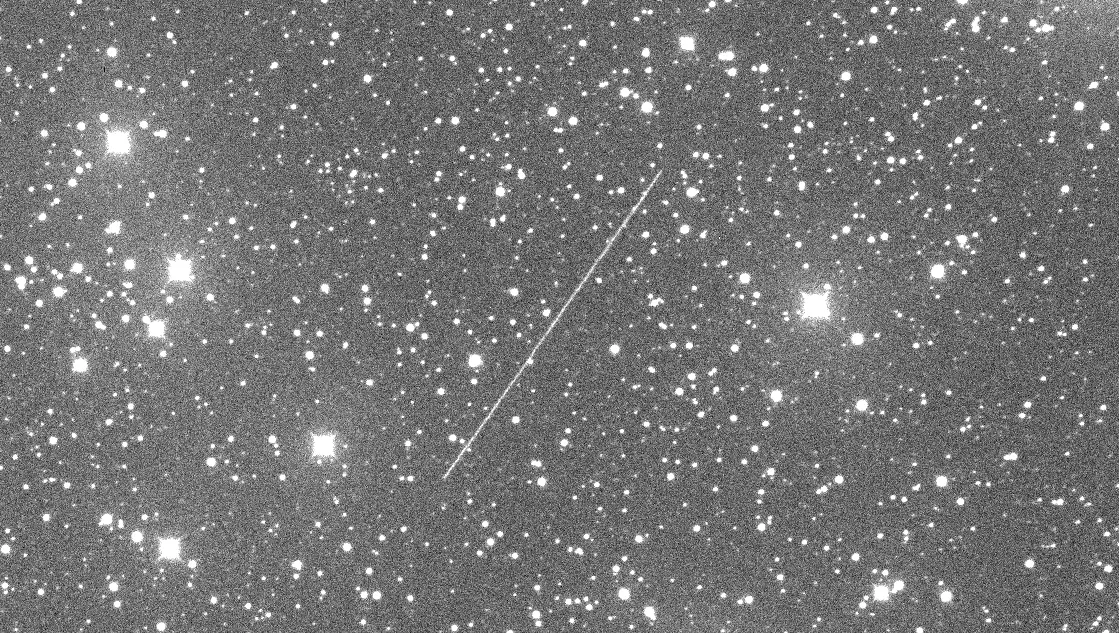
A newfound asteroid gave Earth a close shave early today, zipping between our planet and the moon just two days after astronomers first spotted it.
The near-Earth asteroid 2012 XE54, which was discovered Sunday (Dec. 9), came within 140,000 miles (230,000 kilometers) of our planet at about 5 a.m. EST (1000 GMT) Tuesday (Dec. 11), researchers said. For comparison, the moon orbits Earth at an average distance of 240,000 miles or so (386,000 km).
Astronomers estimate that 2012 XE54 is about 120 feet (36 meters) wide — big enough to cause substantial damage if it slams into Earth someday. An object of similar size flattened 800 square miles (2,000 square km) of forest when it exploded above Siberia's Podkamennaya Tunguska River in 1908.
Asteroid 2012 XE54 also passed through Earth's shadow a few hours before its closest approach, generating an eclipse on the space rock's surface, researchers said. [Video: Asteroid 2012 XE54 Flies Closer Than Moon]
"Asteroids eclipsing during an Earth flyby are relatively rare," astronomer Pasquale Tricarico, of the Planetary Science Institute in Tucson, Ariz., wrote in a blog post Monday (Dec. 10).
The first known case, Tricarico added, was "asteroid 2008 TC3 which was totally eclipsed just one hour before entering Earth's atmosphere over Sudan in 2008, and asteroid 2012 KT42 experiencing both an eclipse and a transit during the same Earth flyby in 2012."
2012 XE54 will be coming back to Earth's neighborhood before too much longer. The asteroid completes one lap around the sun every 2.72 years.
Get the world’s most fascinating discoveries delivered straight to your inbox.
Scientists have discovered about 9,000 near-Earth asteroids to date, but perhaps a million or more such space rocks are thought to exist.
And some of them are potentially dangerous. Observations by NASA's WISE space telescope suggest that about 4,700 asteroids at least 330 feet (100 m) wide come uncomfortably close to our planet at some point in their orbits.
So far, researchers have spotted less than 30 percent of these large space rocks, which could obliterate an area the size of a state if they slammed into Earth.
But there are much bigger asteroids out there, such as 4179 Toutatis, a 3-mile-wide (5 km) behemoth that's in the process of flying by Earth now. Toutatis will remain 4.3 million miles (7 million km) away during its closest approach Wednesday morning, but it may come closer on future passes.
Toutatis would inflict devastating damage if it slammed into Earth, perhaps extinguishing human civilization. The asteroid thought to have killed off the dinosaurs 65 million years ago was about 6 miles (10 km) wide, researchers say.
This story was provided by SPACE.com, a sister site to Live Science. Follow SPACE.com senior writer Mike Wall on Twitter @michaeldwall or SPACE.com @Spacedotcom. We're also on Facebook and Google+.
