













Cheating and Corruption Rampant Among … Ants

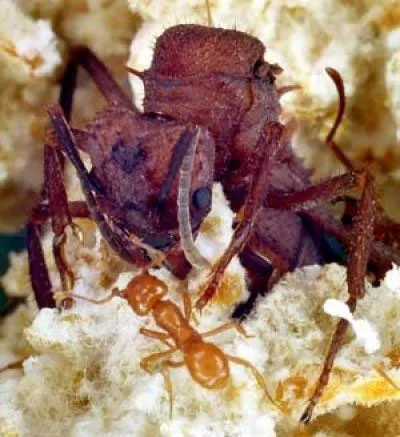
Although ants are noted for their communal cooperation, the ranks of ant royalty are actually riddled with cheating and corruption, a new study finds.
Ant queens were thought to be the products of nurturing, as certain larvae were fed foods that prompted their development into queens, with any larvae having an opportunity to ascend to the royal ranks.
But researchers who used DNA fingerprinting on five colonies of leaf-cutting ants found that the offspring of some fathers were more likely to become reproductive queens than others.
"These ants have a 'royal' gene or genes, giving them an unfair advantage and enabling them to cheat many of their altruistic sisters out of their chance to become a queen themselves," said study team member Bill Hughes of the University of Leeds in the U.K.
Hughes and his co-author, Jacobus Boomsma of the University of Copenhagen, also noted that these "royal" lines were always rare in the colonies.
"If there were too many of one genetic line developing into queens in a single colony, the other ants would notice and might take action against them," Hughes said. "So we think the males with these royal genes have evolved to somehow spread their offspring around more colonies and so escape detection. The rarity of the royal lines is actually an evolutionary strategy by the cheats to escape suppression by the altruistic masses that they exploit.”
So although ants were once thought to be an exception to the foul play that plagues other cooperative societies, including our own, these cheating ants show that isn't the case, Hughes said.
Get the world’s most fascinating discoveries delivered straight to your inbox.
Hughes's research is detailed in the March 10 issue of the journal Proceedings of the National Academy of Sciences.
- Top 10 Insect Secret Weapons
- Images: Ants of the World
- Why Ants Rule the World
