














Stunning Photo: 'Sundogs' Seen Over South Pole

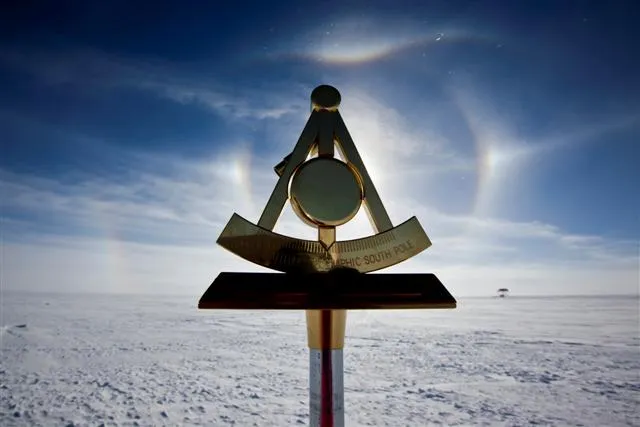
This amazing photo of an atmospheric phenomenon known as a sundog was snapped over the geographic South Pole on Dec. 30, 2011.
Sundogs form when sunlight passes through hexagonal, plate-shaped ice crystals in cirrus clouds, which act like a prism and refract light, according to a NASA release. Also known as parhelia, they can be seen anywhere in the world, but are most visible when the sun is low in the sky.
They are similar to rainbows in that both are formed by refraction. When light is refracted, it is bent by passing through mediums of different densities, such as water or a prism.
If the crystals are randomly oriented, a complete ring or halo around the sun can sometimes be seen. As ice crystals fall through the air, however, they can become horizontally aligned, in which case they form individual circles or arcs of light, as in this picture. That's why they have also been called mock or phantom suns.
Sundogs are similar to a phenomenon called glories, which appear as circular rings of color.
The geographic South Pole is denoted by this marker, put there in 2011. The geographic South Pole is the spot where the Earth's (imaginary) rotation axis would intersect the surface, at least usually. There is some wobble in Earth's orbit, though, so the location is not always a precise one.
Follow OurAmazingPlanet on Twitter @OAPlanet. We're also on Facebook and Google+.
Get the world’s most fascinating discoveries delivered straight to your inbox.
