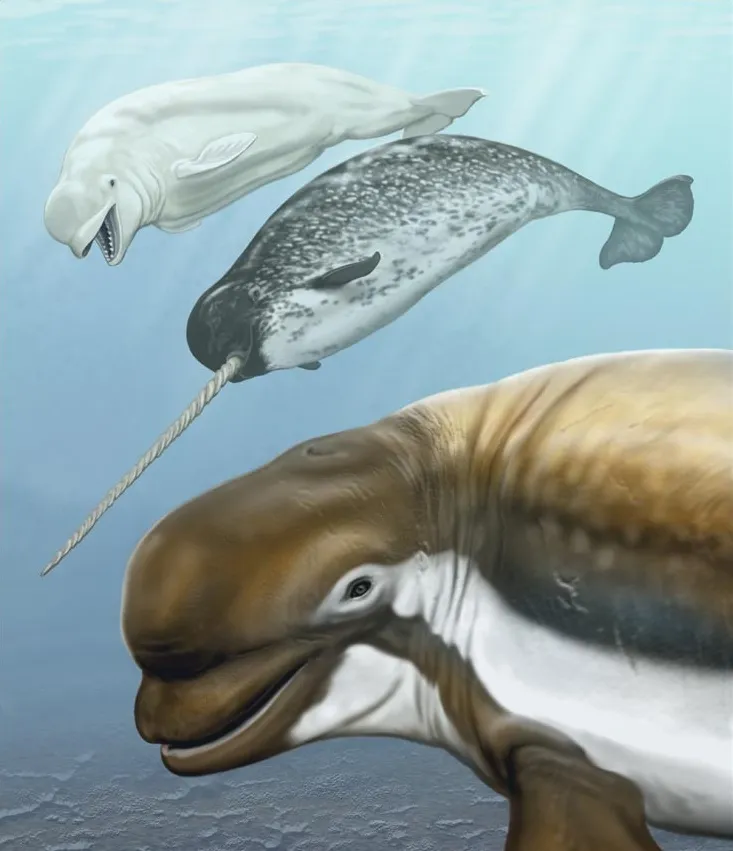
An ancient beast related to today's Arctic-loving beluga whales and narwhals seemed to prefer toasty, tropical waters.
Called Bohaskaia monodontoides, the new species of toothed whale lived some 3 million to 4 million years ago during the Pliocene in warm water. Researchers aren't sure why modern belugas have left these tropical destinations and strayed pole-ward, where life would seem to be more difficult.
This is the fossil skull of a Bohaskaia monodontoides.
(Image credit: Jorge Velez-Juarbe)
The fossil had been sitting in the collections of the Smithsonian's National Museum of Natural History since its discovery in a mine near Hampton, Va., in 1969. The nearly complete skull represents the only fossilized remains known of the new species. Before it was closely examined, the skull's discoverers loosely identified it as a beluga whale and left it in storage.
In 2010, Jorge Velez-Juarbe, Smithsonian pre-doctoral fellow from Howard University, finally took a close look at the skull. He compared it with the skulls of closely related toothed whales, like modern Arctic belugas and narwhals (also called unicorns of the sea for their twisted horn). While the skull shared many features, particularly in the face and snout, with modern toothed whales, the researchers say there are enough unique features to merit its placement in a new genus and species.
"We realized this skull was not something assignable to a beluga, and when we sat down, comparing the fossil side by side with the actual skulls of belugas and narwhals, we found it was a very different animal," study researcher Nicholas Pyenson, of the Smithsonian's National Museum of Natural History, said in a statement.
Smithsonian scientists (left to right) Jorge Velez-Juarbe holds the skull of beluga whale; Dave Bohaska holds the skull of Bohaskaia monodontoides; and Nicholas Pyenson with the skull and tusk of a narwhal. They are standing in the marine mammal collections area of the Smithsonian’s National Museum of Natural History.
(Image credit: Jorge Velez-Juarbe)
This and a second temperate example of a beluga-related whale indicate that the love of frosty water developed recently in these whales. [Image Gallery: Life at the North Pole]
"The fact is that living belugas and narwhals are found only in the Arctic and sub-Arctic, yet the early fossil record of the monodontids extends well into temperate and tropical regions," Pyenson said. "For evidence of how and when the Arctic adaptations of belugas and narwhals arose we will have to look more recently in time."
Sign up for the Live Science daily newsletter now
Get the world’s most fascinating discoveries delivered straight to your inbox.
Velez-Juarbe said the narwhals and belugas may have changed habitats due to oceanic changes that affected the food chain: Either competition with other animals or the movement of a preferred prey species could have driven them north.
The new analysis of the whale skull is published in the Journal of Vertebrate Paleontology.
You can follow LiveScience staff writer Jennifer Welsh on Twitter @microbelover. Follow LiveScience for the latest in science news and discoveries on Twitter @livescience and on Facebook.
Jennifer Welsh is a Connecticut-based science writer and editor and a regular contributor to Live Science. She also has several years of bench work in cancer research and anti-viral drug discovery under her belt. She has previously written for Science News, VerywellHealth, The Scientist, Discover Magazine, WIRED Science, and Business Insider.