














Monarch Butterfly Numbers Take a Hit
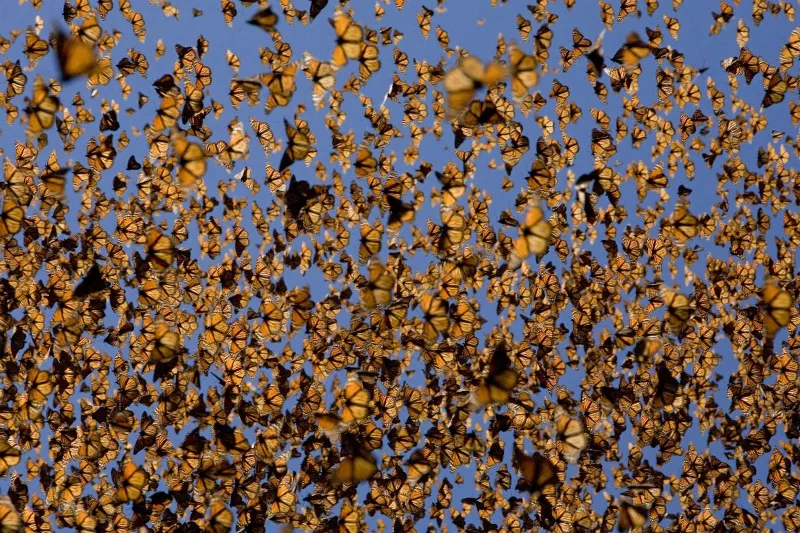
Monarch butterflies have taken a hit this year, according to researchers who monitor the colorful insects' numbers at their traditional overwintering grounds in a forest in central Mexico.
This winter's surviving population covers only about 7 acres (2.89 hectares), almost a third less than the area the butterflies covered in the 2010-2011 season.
Each winter, the world's monarchs gather in a single swath of evergreen forest in Michoacán, Mexico, to spend the cooler months clustered together in a state of torpor, blanketing the trees by the thousands.
This so-called "supergeneration" flies from its birthplace, in the northern United States and Canada, to the same patch of Mexican forest, year after year.
The announcement from researchers with WWF and Mexico's National Commission for Natural Protected Areas appears to confirm the fears of some biologists, who said it was likely that scalding temperatures and extreme droughts affecting Texas and other parts of the United States in 2011 would take a toll on the butterflies.
The migrating monarchs can survive for only so long without nectar or water, and the leg of their journey through parched regions of the U.S. was likely a difficult one.
"I call that a thousand miles of hell, from Oklahoma down to Mexico," Chip Taylor, a professor and insect ecologist at the University of Kansas, and the director of Monarch Watch, a nonprofit outreach organization, told OurAmazingPlanet in November.
Get the world’s most fascinating discoveries delivered straight to your inbox.
In recent years, winter monarch colonies appear to be shrinking. Since 1994, the average coverage is 18 acres (7 hectares), but the lowest numbers ever recorded have all occurred in the last 11 years, with a new record low in 2009 of a mere 5 acres (2 hectares) — an area only about one-eighth larger than the average Walmart Supercenter store.
Overall, monarch populations have declined significantly over the last two decades. Deforestation in Mexico has been a factor, according to some biologists. Taylor says agricultural practices in the United States also play an outsize role in the butterflies' demise.
The liberal use of herbicides has killed off milkweed — the only plant upon which the butterflies lay their eggs — from some 140 million acres (57 million hectares) in North America the last 10 years, Taylor said.
Reach Andrea Mustain at amustain@techmedianetwork.com. Follow her on Twitter @AndreaMustain. Follow OurAmazingPlanet for the latest in Earth science and exploration news on Twitter @OAPlanet and on Facebook.