














Physicists Entangle 8 Photons in 'Spooky' Experiment
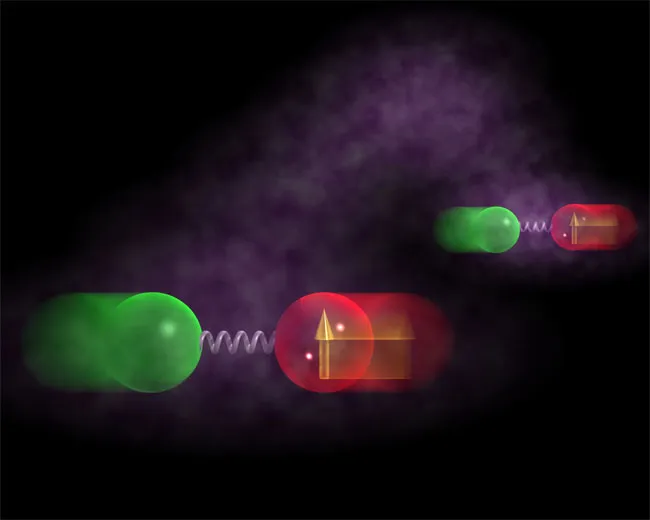
The quantum phenomenon known as entanglement keeps spreading its arms to hold ever more particles in its spooky embrace.
Quantum entanglement is an effect through which multiple particles share correlated properties—across arbitrarily large distances—that snap into place instantaneously. For instance, a pair of entangled photons in different locations might be joined by their polarizations, a property that describes the orientation of a light wave’s oscillation. Measure one photon’s polarization, and the polarization of the other instantly assumes the same value. In other words, the photons are either both horizontally polarized or both vertically polarized, but neither assumes a definite value until one or the other is measured.
If that strikes you as more than a little counterintuitive, you’re in good company. Albert Einstein once disparaged quantum entanglement as “spooky action at a distance.” As he and his colleagues wrote in 1935, “No reasonable definition of reality could be expected to permit this.” Reasonable or no, entanglement indeed appears to be a part of reality, as numerous experiments have demonstrated.
Now, experimenters at the University of Science and Technology of China (USTC) in Shanghai have entangled not one but four pairs of photons, linking the polarizations of eight photons. The achievement, described in a study published online February 12 in Nature Photonics, extends the range of previous experiments that had entangled up to six photons. (Scientific American is part of Nature Publishing Group.) Even larger ensembles have been entangled using individual atoms as the particle of choice, but entangled photons hold much promise for quantum communication schemes, since they can carry messages across large distances.
Entanglement is a fragile state, and entangling photons with any efficiency is a major challenge; physicists generally produce a huge number of photons for every pair of successfully entangled particles. The difficulty of creating multiple pairs of entangled photons grows exponentially as more are added. Xing-Can Yao and his colleagues at USTC calculated that if they simply extended previous six-photon experiments to include another pair of entangled photons, it would take roughly 10 hours of experimental time to generate one entangled eight-photon set. (Physicists verify the presence of entanglement by running statistical tests that require large samples of photons, so an experiment that takes hours to produce a single entangled state is impractically slow.) To overcome that limitation, the researchers used an optical scheme that filters out fewer photons and hence boosts the output of entangled photons.
With a “bright” source of entangled photons, the researchers managed to generate four mutually entangled pairs with much greater frequency. They reported detecting hundreds of sets of entangled photons, at a rate of about nine per hour, which sufficed to run the kinds of statistical tests needed to verify that all eight photons were indeed linked at the quantum level.
For a lighthearted, conceptual take on entanglement, check out the recent video that I made with Scientific American‘s resident entanglement expert George Musser, along with our colleagues Mary Karmelek and Eric Olson.
Get the world’s most fascinating discoveries delivered straight to your inbox.
About the Author: John Matson is an associate editor at Scientific American focusing on space, physics and mathematics. Follow on Twitter @jmtsn.
This article was first published on Scientific American. © 2012 ScientificAmerican.com. All rights reserved. Follow Scientific American on Twitter @SciAm and @SciamBlogs. Visit ScientificAmerican.com for the latest in science, health and technology news.