Live Science Plus






Ultrathin, Foldable Sensors Probe Secrets of the Brain
You are now subscribed
Your newsletter sign-up was successful
Want to add more newsletters?

Delivered Daily
Daily Newsletter
Sign up for the latest discoveries, groundbreaking research and fascinating breakthroughs that impact you and the wider world direct to your inbox.

Once a week
Life's Little Mysteries
Feed your curiosity with an exclusive mystery every week, solved with science and delivered direct to your inbox before it's seen anywhere else.

Once a week
How It Works
Sign up to our free science & technology newsletter for your weekly fix of fascinating articles, quick quizzes, amazing images, and more

Delivered daily
Space.com Newsletter
Breaking space news, the latest updates on rocket launches, skywatching events and more!

Once a month
Watch This Space
Sign up to our monthly entertainment newsletter to keep up with all our coverage of the latest sci-fi and space movies, tv shows, games and books.

Once a week
Night Sky This Week
Discover this week's must-see night sky events, moon phases, and stunning astrophotos. Sign up for our skywatching newsletter and explore the universe with us!
Join the club
Get full access to premium articles, exclusive features and a growing list of member rewards.
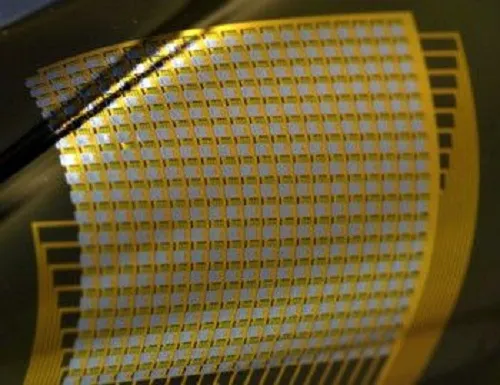
New ultra-thin, flexible sensors can deliver unprecedented views of the brain while dramatically reducing the invasiveness of brain implant devices.
Using the new sensors, researchers have already recorded previously unknown details of sleep patterns and brain activity during epileptic seizures in animals. They hope the new technology will help control seizures and sleep disorders and lead to new understandings of learning, vision, memory, depression, chronic pain and other neurological disorders. Ultimately, they hope to apply the new technology to other implantable devices such as cardiac pacemakers and defibrillators, cochlear and retinal implants and motor prosthetic systems.
The breakthrough technology packs ultrathin, foldable, silicon transistors into dense arrays of thousands of multiplexed sensors, and it uses just a tenth of the wires required by today's technology. The new sensors deliver unprecedented resolution — more than 400 times the current level.
Current implants that record or stimulate brain activity require wires for each individual sensor. The combination of the mass of today's sensors and wires preclude them from important areas of the brain that the new sensors can monitor for the first time, including inside sulci and fissures and even between the cortical hemispheres.
The new arrays cover a much larger brain area with significantly higher resolution, and the surgery to implant them is much less invasive.
The researchers' findings were published in the December issue of Nature Neuroscience. Lead authors are Brian Litt of the University of Pennsylvania and Jonathan Viventi, assistant professor of electrical and computer engineering at Polytechnic Institute of New York University and at the Center for Neural Science at New York University. John Rogers of the University of Illinois Urbana-Champaign and Dae-Hyeong Kim of Seoul National University, in South Korea are also part of the team that conceived and built the array.
The research was conducted with support from the U.S. National Institutes of Health's National Institute of Neurological Disorders and Stroke and National Heart, Lung, and Blood Institute, the National Science Foundation, the U.S. Department of Energy Division of Materials Sciences and Engineering, Citizens United for Research in Epilepsy, and the Dr. Michel and Mrs. Anna Mirowski Discovery Fund for Epilepsy Research.
For more information, check out this press release from the Polytechnic Institute of New York University and this press release from the University of Pennsylvania.
Editor's Note: Any opinions, findings, and conclusions or recommendations expressed in this material are those of the author and do not necessarily reflect the views of the National Science Foundation. See the Research in Action archive.