
 Live Science Plus


Turning Tadpole Against Tadpole to Fight Toxic Toad

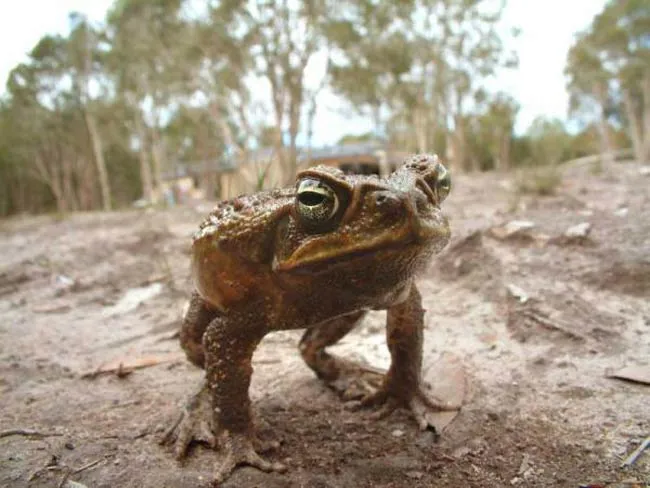
It's a tadpole-eat-tadpole world out there — and that's exactly what Australian scientists are hoping will control the spread of a giant invasive toad with toxic flesh.
The cane toad (Bufo marinus), which can weigh up to 3 pounds (1.4 kg), is a scourge in Australia. Introduced in the 1930s to control beetles that fed on sugar cane, the toads soon became their own ecological nightmare, competing with local wildlife for food. The toads' skin is highly toxic, threatening house pets and native predators such as the Northern quoll, an endangered marsupial.
The toads are also locked into a life-or-death conflict for food and space with each other, especially as tadpoles. A new study suggests that ecologists could turn the toads' own survival strategies against them, using pheromones released by older tadpoles to weaken younger ones.

Controlling the cane toad
So far, the most common way of trying to keep the cane toad in check involves capturing and removing the amphibians. That can help in some situations, but it won't halt the march of toads for long, according to Rick Shine, an evolutionary biologist at the University of Sydney who studies cane toad ecology.
"Ultimately, the answer to toad control on a landscape scale will have to involve methods that don't require constant input of effort," Shine and his colleagues wrote on their research outreach website, canetoadsinoz.com.
Cane toads lay a large number of eggs, producing many tadpoles that must compete for limited food. From the beginning, this competition is deadly: Older tadpoles eat yet-to-be-hatched eggs, eliminating the competition before it's born. But Shine and his colleagues wondered if tadpoles had any other tricks to keeping down younger generations. After all, they reasoned, tadpoles produce chemicals called pheromones for communication. It would make sense if the tadpoles had evolved some of those pheromones to disrupt the development of any toad eggs they couldn't find and eat.
Get the world’s most fascinating discoveries delivered straight to your inbox.

In the new study, published today (Aug. 30) in the journal Biology Letters, the researchers trapped adult cane frogs and induced them to lay eggs in 20 containers. In 10 of the containers, they added three cane toad tadpoles caught in nearby ponds. The tadpoles were kept from the eggs with a mesh screen to prevent any experiment-ruining egg-eating.
As the eggs developed and hatched, the researchers tested the water quality and also euthanized some tadpoles to be measured and weighed. They let other tadpoles develop and metamorphose into toads, measuring how long it took to reach that transition point.
Stunted tadpoles
The water in the tadpole-bearing containers remained well within the range of survivability for toad eggs, although the ammonia concentration increased, the researchers found. But the newly hatched tadpoles did not fare well when exposed to older tadpoles.
Having tadpoles nearby reduced the viability of the larvae that hatched from the eggs, meaning more died in their first five days of life than in the containers without older tadpoles. After five days, the researchers found that the young tadpoles exposed to older tadpoles were 24 percent shorter and weighed 41 percent less than the unexposed tadpoles. At metamorphosis, when tadpoles become toads, the exposed tadpoles were 11 percent shorter and 45 percent lighter than unexposed tadpoles, and 40 percent fewer survived to that point.
The results suggest these savvy older tadpoles were releasing a lethal chemical into the water.
More work is necessary to find out whether isolating and adding this chemical to real ponds and bogs could control toads, the researchers wrote. On their website, they discuss experiments in which they added the "alarm chemical" excreted by tadpoles to egg-laden water, killing half of the tadpole larvae. The ones that lived were two-thirds normal size when they became toads.
"Adding the alarm chemical to ponds can kill many toad tadpoles without affecting frog tadpoles, and can 'miniaturize' the emerging toadlets," the researchers wrote on the website.
In a best-case scenario, the alarm chemical treatment could be combined with another anti-toad weapon, a parasite that infects and kills baby toads, Shine and his colleagues added. Together, the pheromone and the parasite could pack a deadly one-two punch. [Top 10 Diabolical, Disgusting Parasites]
"We have found a parasite that kills toads, but does not naturally infect Australian frogs; and an alarm chemical that kills tadpoles of toads, but not Australian frogs," Shine and his colleagues wrote. "And a combination of the two weapons will work even better, because the alarm chemical makes toads transform from tadpoles into toadlets at a smaller size, and so makes them even more vulnerable to the parasite."
You can follow LiveScience senior writer Stephanie Pappas on Twitter @sipappas. Follow LiveScience for the latest in science news and discoveries on Twitter @livescience and on Facebook.

Stephanie Pappas is a contributing writer for Live Science, covering topics ranging from geoscience to archaeology to the human brain and behavior. She was previously a senior writer for Live Science but is now a freelancer based in Denver, Colorado, and regularly contributes to Scientific American and The Monitor, the monthly magazine of the American Psychological Association. Stephanie received a bachelor's degree in psychology from the University of South Carolina and a graduate certificate in science communication from the University of California, Santa Cruz.