













Key to Swaying Mass Opinion Found

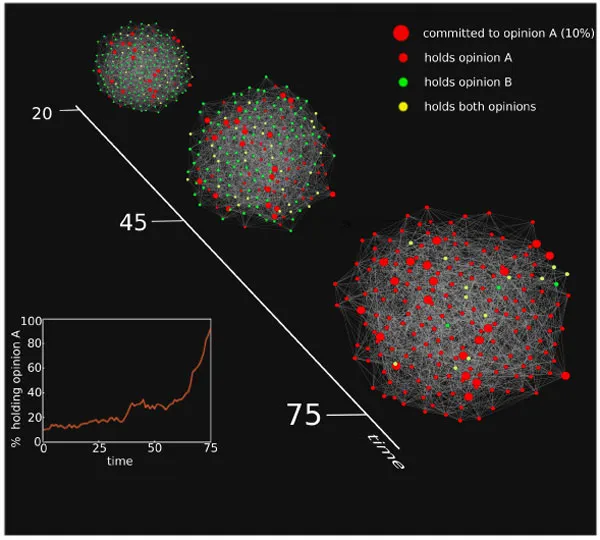
For an opinion or belief, 10 percent is critical mass. If that proportion of the population emphatically embraces an idea, then it will spread rapidly to the majority of the population, scientists have found.
"When the number of committed opinion holders is below 10 percent, there is no visible progress in the spread of ideas," said researcher Boleslaw Szymanski, director of the Social Cognitive Networks Academic Research Center at Rensselaer Polytechnic Institute. "Once that number grows above 10 percent, the idea spreads like flame."
For example, dictators who held power for decades in Tunisia and Egypt were overthrown in a matter of weeks when events pushed public opinion past the 10 percent threshold, Szymanski said.
Szymanski and colleagues tested out the spread of opinion using computer models of different social networks — one in which everyone was connected to everyone else, one with a few well-connected people and one in which everyone had the same, limited number of connections. In all cases, a few people within the network held an unwavering, but uncommon, belief; everyone else held a traditional view but was open-minded.
They found that, regardless of the type of network, 10 percent remained the threshold required to shift the majority opinion once the true believers began to speak with everyone else. [Cooperation Is Contagious]
This finding has broad implications for understanding how opinion spreads, according to the researchers.
"There are clearly situations in which it helps to know how to efficiently spread some opinion or how to suppress a developing opinion," said Gyorgy Korniss, a study researcher and associate professor of physics at Rensselaer. "Some examples might be the need to quickly convince a town to move before a hurricane or spread new information on the prevention of disease in a rural village."
Get the world’s most fascinating discoveries delivered straight to your inbox.
The findings were published July 22 online in the journal Physical Review E.
