













Delving Into the Mind of a Dictator

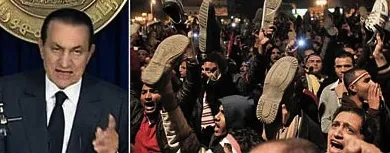
The real thoughts and motivations of Egyptian President Hosni Mubarak, who stepped down one day after refusing to cede power, may never be truly known. Even so, psychologists and political scientists who have studied past dictators and authoritarian figures think they have a read on a man who held desperately to power for 30 years.
Turns out, Mubarak may have less in common than one might expect with brutal dictators. And his loathing to give up power may have to do with an underlying identity crisis of sorts in which he came to see himself as Egypt, scientists say.
Now that Mubarak has left a pedestal he held for so long, fleeing Cairo for the resort town of Sharm el-Sheikh, his physical and mental health will likely take a hit as the shock sinks in. [Read: Could You Become a Dictator? ]
Malignant narcissism
Dictators tend to share certain traits, researchers say, including a willingness to shut down opposition with brutality. Consider Joseph Stalin, who ruled Russia with an iron fist from 1924 to 1953. Official Russian counts from the time suggest that Stalin was responsible for three million executions and deaths in gulags alone. Some scholars place his body count as high as 60 million.
This disregard for life might seem to be the mark of a madman, said Paul Gregory, an economist at the University of Houston and the author of "Politics, Murder and Love in Stalin's Kremlin: The Story of Nicolai Bukharin and Anna Larina" (Hoover Institution Press, 2010). But in a study published online Dec. 7, 2010, in the Journal of Comparative Economics, Gregory contends that Stalin's actions were chillingly rational. By analyzing Soviet records, Gregory found that Stalin killed more innocent citizens when information about true political enemies was foggy. In other words, when he knew his enemies, he took them out. When he didn't, he cast a wider net.
"If your true enemies are concealing themselves, it makes sense to overkill," Gregory told LiveScience. "The cost of killing an innocent person is low or zero as far as the dictator is concerned."
Get the world’s most fascinating discoveries delivered straight to your inbox.
Stalin's behavior is typical of the "malignant narcissism" of many dictators, said Jerrold Post, the director of the political psychology program at George Washington University and author of "Leaders and Their Followers in a Dangerous World" (Cornell University Press, 2004).
Malignant narcissists share grandiose dreams of glory, little empathy for others, paranoia and the willingness to use whatever aggression is necessary to meet their goals, Jerrold told LiveScience. And although Mubarak's regime allowed torture and repression, the former Egyptian president lacked the sadism of a Stalin or a Saddam Hussein, both of whom were known for sending close advisers home in body bags.
"I think he's really more of an authoritarian personality," Jerrold said of Mubarak.
Old and out of touch
Jerrold blames Mubarak's out-of-touch reaction to the protests in part on his age. When a nation revolts against an aging dictator, Jerrold said, the leader's response is usually to dig in. Longstanding dictators rarely realize that what worked in the past may no longer help them hold onto power, he said.
"People call on past repertories to look at present problems, and in doing so, may not really be able to respond creatively to the moment," Jerrold said.
Mubarak's speech the night before he stepped down suggests he also had trouble differentiating his own well-being from Egypt's, said Georgi Derlugian, a sociologist at Northwestern University who studies revolutions.
"Dictators that have been in power for a long time identify themselves more and more with their own country," Derlugian told LiveScience. Mubarak, like many dictators, likely viewed repression and torture of his people as a way to protect himself and, by extension, Egypt, Derlugian said.
As far as the dictator is concerned, "that's what service to the nation requires," Derlugian said. "There's no contradiction in their mind."
Where deposed dictators go
It's not yet clear why Mubarak gave a defiant speech yesterday (Feb. 10) only to hand over power today (Feb. 11). But voluntarily handing over power is all but impossible for entrenched dictators, Derlugian said.
"Mubarak remained in power decade after decade, seeing presidents of other countries come and go, seeing governments of Israel come and go and hearing year after year that he was responsible for keeping peace and stability in the most dangerous region in the world," Derlugian said. "By the time you're 70 or 80 years old, your personal identity has completely merged with this historical role."
Without his power, Derlugian said, Mubarak is likely to "spend a lot of time in shock and puzzlement." He may be unable to understand what went wrong. The shock of loss may even affect his health, Derlugian said.
"A lot of dictators who pass from power in this way develop severe coronary or other illness," Derlugian said. "It's like this shocking divorce, or the loss of a loved one."
You can follow LiveScience Senior Writer Stephanie Pappas on Twitter @sipappas.

Stephanie Pappas is a contributing writer for Live Science, covering topics ranging from geoscience to archaeology to the human brain and behavior. She was previously a senior writer for Live Science but is now a freelancer based in Denver, Colorado, and regularly contributes to Scientific American and The Monitor, the monthly magazine of the American Psychological Association. Stephanie received a bachelor's degree in psychology from the University of South Carolina and a graduate certificate in science communication from the University of California, Santa Cruz.