













First ancient mammoth image discovered in Americas

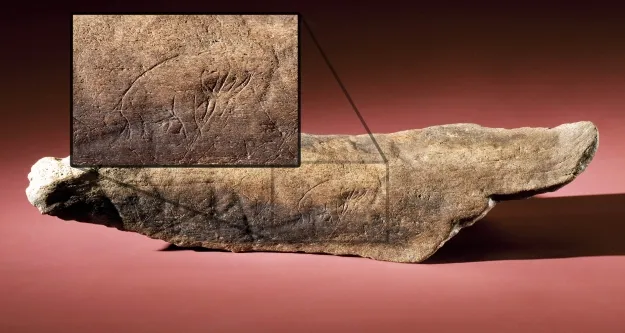
Hundreds of images of the now extinct mammoths and mastodons — elephant-like animals hunted by prehistoric people — have been found in Europe, but none had surfaced in the Americas, until now.
A fragment of bone, discovered in Vero Beach, Fla., by a fossil hunter, bears a 3-inch-long, 1.75-inch tall (7.62 centimeters by 4.45 centimeters) engraving of a trunked creature, whose shortened, high-domed skull and longer forelimbs evoke the body of a mammoth, according to researchers, led by Barbara Purdy of the University of Florida.
If genuine, this rare and spectacular find provides evidence that ancient people living in the Americas during the end of the Pleistocene Epoch created artistic images of the animals they hunted, Purdy and her colleagues write online in the Journal of Archaeological Science.
Mammoths and their mastodon relatives disappeared approximately 13,000 years ago, at the end of the Pleistocene Epoch, so this image must have been carved by that time, according to the researchers.
Related: 25 amazing ancient beasts
The bone itself appears to have belonged to a large mammal, most likely a mastodon or mammoth, or less likely, a giant sloth, they write. [Image of carving]
The image on the bone is not readily apparent, and the fossil hunter who discovered it, James Kennedy, did not notice it for two or three years after collecting the bone. When a cleaning revealed the engraving, Kennedy contacted researchers.
Get the world’s most fascinating discoveries delivered straight to your inbox.
RELATED CONTENT
The researchers set out to verify that the carving was indeed created by ancient people using a variety of analytical and imaging techniques.
"All of these results are consistent with the mammoth engraving being authentic," they conclude.
Originally published on Live Science.
