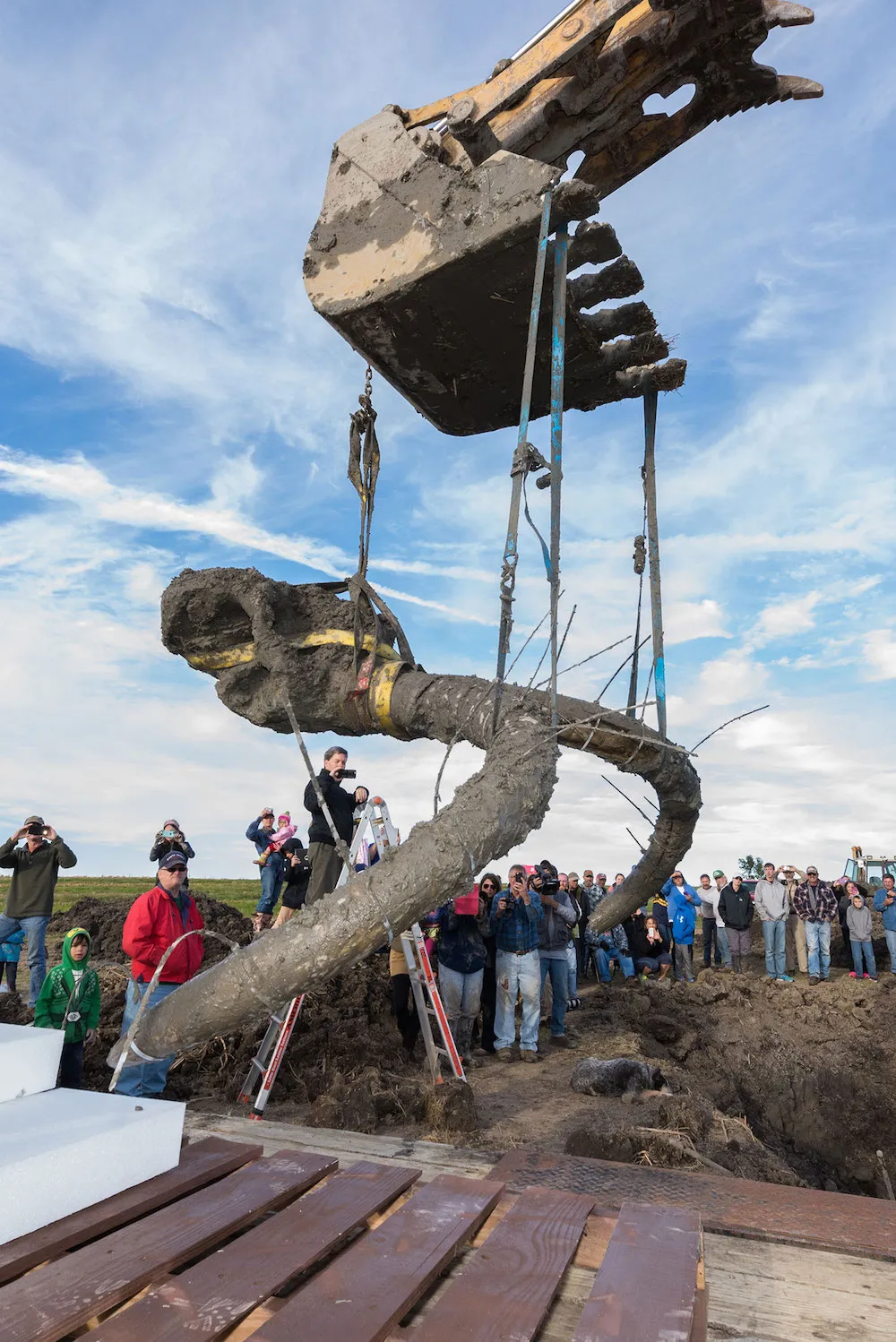
A Michigan farmer unexpectedly discovered mammoth bones on his property, buried in the soil beneath a wheat field. He gave paleontologists at the University of Michigan a day to excavate the bones, and their fast work uncovered about 20 percent of the beast's bones. The remains are those of an adult male mammoth that likely lived 11,700 to 15,000 years ago, the researchers found. (Image credit: Daryl Marshke | Michigan Photography) [Read the Full Story on the Michigan Mammoth]
An amazing find
A mammoth skull and tusks are lifted from the ground at a farm southwest of Ann Arbor, at an unincorporated site in Washtenaw County, Michigan.
As the mammoth skull and tusks are raised from the pit, paleontology doctoral candidate John Fronimos watches.
Making the news
A crowd of locals watches the excavation at the field in Lima Township.
Sign up for the Live Science daily newsletter now
Get the world’s most fascinating discoveries delivered straight to your inbox.
Ancient tool
University of Michigan graduate student Ashley Lemke and paleontologists Joe El Adli and Daniel Fisher examine a stone flake found near the animal's tusks during the excavation. The flake may be a tool that ancient people used to cut the mammoth.
A piece of the puzzle
El Adli carries a mammoth vertebra during the dig.
Securing the bones
A group harnesses the mammoth bones with straps before hauling them out of the pit. From left to right: Lemke, Earth and environmental sciences undergraduate student Jessica Hicks, Fronimos, Fisher and El Adli.
Removing the bones
Two team members guide the right tusk of the mammoth as the skull is lifted gently from the excavation pit.
Securing the treasure
David Vander Weele, an Earth and environmental sciences undergraduate student at the University of Michigan, oversees the mammoth tusks and skull as they are secured onto a flatbed trailer.
Loading the mammoth
University of Michigan collections manager Adam Rountrey (left), Vander Weele (center) and paleontology doctoral candidate Michael Cherney (right) help load the mammoth skull and tusks onto a flatbed trailer.
Laura is the managing editor at Live Science. She also runs the archaeology section and the Life's Little Mysteries series. Her work has appeared in The New York Times, Scholastic, Popular Science and Spectrum, a site on autism research. She has won multiple awards from the Society of Professional Journalists and the Washington Newspaper Publishers Association for her reporting at a weekly newspaper near Seattle. Laura holds a bachelor's degree in English literature and psychology from Washington University in St. Louis and a master's degree in science writing from NYU.