















Japan Earthquake Was 'In the Air' Days Before, Scientist Claims

On March 11, 2011, at 2:46 p.m. local time (05:46 UTC), a magnitude 8.9 earthquake struck off the east coast of Japan. The epicenter was 80 miles (130 kilometers) east of Sendai, and 231 miles (373 km) northeast of Tokyo. If initial measurements are confirmed, it will be the world’s fifth largest earthquake since 1900 and the worst in Japan's history.
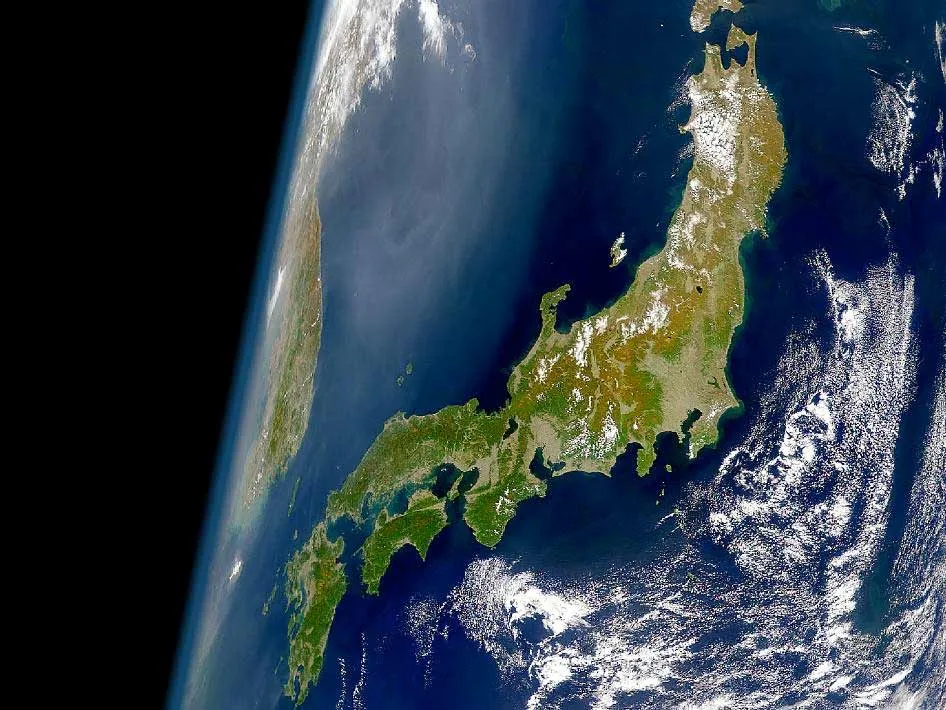
This image of Japan from 1999 was taken as part of SeaWiFS, the Sea-viewing Wide Field-of-view Sensor Project.
The atmosphere above the epicenter of the March 11 earthquake in Japan underwent unusual changes in the days leading up to the disaster, according to preliminary data.
The research has not yet been published in an academic journal or reviewed by other scientists, but it could offer an intriguing possibility for earthquake prediction — though the day scientists are able to forecast earthquakes is still "far away," said study researcher Dimitar Ouzounov, a professor of earth sciences at Chapman University in California.
Looking to the sky in hopes of predicting an earthquake is not a new idea. The theory, which in science circles is called "Lithosphere-Atmosphere-Ionosphere Coupling mechanism," goes like this: Right before an earthquake, the stressed fault releases more gases, especially the colorless, odorless radon gas. Once in the upper-atmosphere ionosphere, the radon gas strips air molecules of their electrons, splitting them into negatively charged particles (the free electrons) and positively charged particles. These charged particles, called ions, attract condensed water in a process that releases heat. [Infographic: Tallest Mountain to Deepest Ocean Trench]
And scientists can detect this heat in the form of infrared radiation.
Using satellite data, Ouzounov and his colleagues looked at what the atmosphere was doing in the days before the Japanese quake. They found that the concentration of electrons in the ionosphere increased in the days before the earthquake, as did infrared radiation. March 8, three days before the quake, was the most anomalous day, Ouzounov told LiveScience. [Read: The Science Behind Japan's Deadly Earthquake]
The researchers have crunched data for more than 100 quakes in Asia and Taiwan, Ouzounov said, and have found similar correlations for earthquakes with magnitudes bigger than 5.5 and depths less than 31 miles (50 kilometers). The team is now working to involve researchers in Japan and worldwide, as ambitious atmosphere monitoring will take international effort, Ouzounov said.
Nonetheless, the success of earthquake forecasting is far from guaranteed. No one has ever predicted an earthquake from atmospheric data, and plenty of supposed earthquake precursors, from weird animal behavior to groundwater flowing the wrong way, have proven hit-or-miss.
Get the world’s most fascinating discoveries delivered straight to your inbox.
"It's intriguing," said Henry Pollack, an emeritus professor of geophysics at the University of Michigan who was not involved in the research. "But it's hardly what I would call a breakthrough."
To iron out the usefulness of the atmospheric approach, Pollack told LiveScience, you'd need to look at lots of earthquakes over time to make sure the phenomena is statistically linked with fault ruptures. You'd also want to know how often these atmospheric anomalies show up without an associated quake.
Terry Tullis, an emeritus professor of geological sciences at Brown University, was similarly doubtful. Earthquake scientists have been "burned enough times in the past" and so have learned not to get excited about every potential prediction method, Tullis told LiveScience. But plans are underway to put together a workshop between earth scientists and atmospheric scientists this summer to discuss the research on the ionosphere changes, he said.
"I don't want to dismiss it out of hand," Tullis said. "But at this point, one has to be somewhat skeptical."
The full report is available at The Physics arXiv Blog. The researchers have also submitted their research report to a scientific journal.
You can follow LiveScience senior writer Stephanie Pappas on Twitter @sipappas. Follow LiveScience for the latest in science news and discoveries on Twitter @livescience and on Facebook.

Stephanie Pappas is a contributing writer for Live Science, covering topics ranging from geoscience to archaeology to the human brain and behavior. She was previously a senior writer for Live Science but is now a freelancer based in Denver, Colorado, and regularly contributes to Scientific American and The Monitor, the monthly magazine of the American Psychological Association. Stephanie received a bachelor's degree in psychology from the University of South Carolina and a graduate certificate in science communication from the University of California, Santa Cruz.